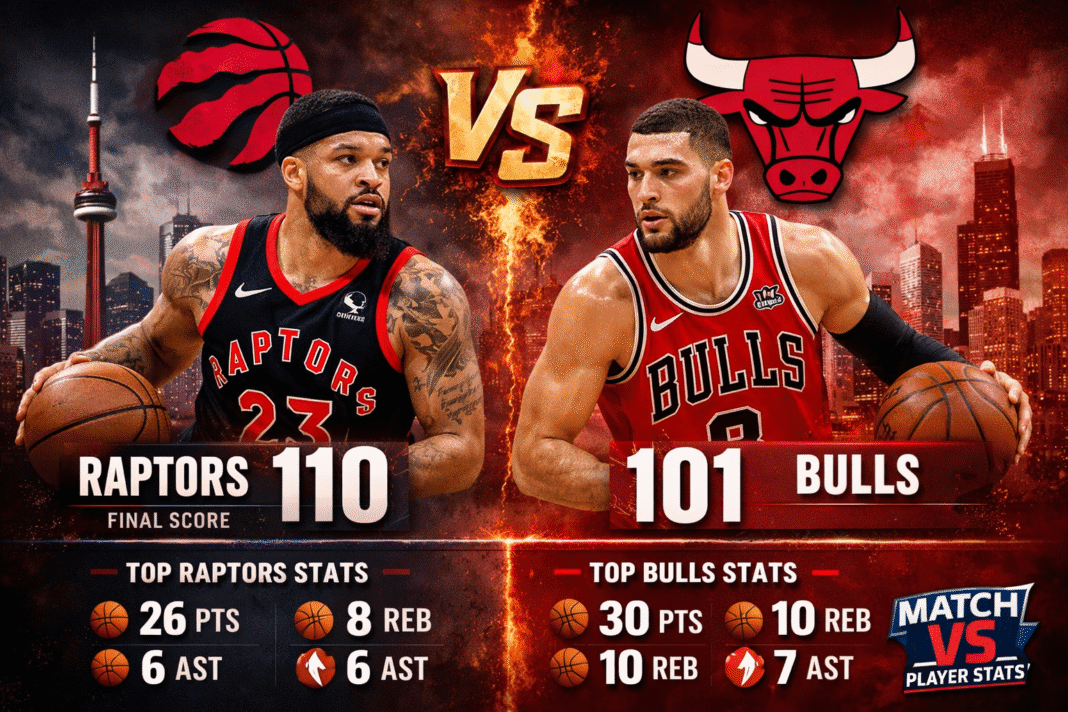
Toronto Raptors 110, Chicago Bulls 101 — Brandon Ingram dropped 31 points, Immanuel Quickley and Scottie Barnes each added 14, and the Raptors controlled this one from start to finish in Chicago. If you came looking for the Toronto Raptors vs Chicago Bulls match player stats from February 19, 2026, you landed in the right place. Every number, every key performance, all laid out below.
Final Score and Quarter-by-Quarter Breakdown
| Quarter | Chicago Bulls | Toronto Raptors |
|---|---|---|
| Q1 | 23 | 25 |
| Q2 | 22 | 28 |
| Q3 | 33 | 34 |
| Q4 | 23 | 23 |
| FINAL | 101 | 110 |
Toronto never really let Chicago back in this one. The Raptors built a comfortable cushion by halftime, led by as many as 14 points, and had enough in the tank to manage the fourth quarter without breaking a sweat.
Toronto Raptors Player Stats
| Player | POS | PTS | REB | AST | STL | BLK | FG | 3PT | FT | +/- |
|---|---|---|---|---|---|---|---|---|---|---|
| Brandon Ingram | F | 31 | 8 | 6 | 2 | 0 | 11/26 | 3/5 | 6/7 | +12 |
| Immanuel Quickley | G | 14 | 2 | 3 | 2 | 0 | 5/12 | 0/4 | 4/5 | +9 |
| Scottie Barnes | F | 14 | 9 | 5 | 2 | 1 | 5/14 | 0/1 | 4/4 | +8 |
| RJ Barrett | G | 13 | 6 | 3 | 1 | 0 | 3/10 | 1/3 | 6/8 | +14 |
| Ja’Kobe Walter | G | 14 | 4 | 0 | 3 | 0 | 4/9 | 2/5 | 4/4 | -4 |
| Collin Murray-Boyles | C | 11 | 6 | 1 | 1 | 1 | 4/5 | 0/0 | 3/3 | +9 |
| Sandro Mamukelashvili | F-C | 7 | 3 | 0 | 0 | 1 | 3/5 | 1/2 | 0/0 | -8 |
| Jamal Shead | G | 4 | 3 | 4 | 2 | 0 | 2/5 | 0/2 | 0/0 | -3 |
| Jakob Poeltl | C | 2 | 0 | 1 | 0 | 0 | 1/1 | 0/0 | 0/0 | +2 |
| Gradey Dick | G-F | 0 | 5 | 0 | 1 | 0 | 0/3 | 0/1 | 0/0 | +6 |
Chicago Bulls Player Stats
| Player | POS | PTS | REB | AST | STL | BLK | FG | 3PT | FT | +/- |
|---|---|---|---|---|---|---|---|---|---|---|
| Anfernee Simons | G | 20 | 1 | 1 | 0 | 0 | 7/18 | 4/11 | 2/2 | -21 |
| Isaac Okoro | F | 16 | 5 | 1 | 0 | 0 | 6/12 | 3/5 | 1/1 | 0 |
| Tre Jones | G | 12 | 1 | 6 | 0 | 1 | 5/8 | 1/1 | 1/2 | +8 |
| Jalen Smith | C | 9 | 10 | 2 | 3 | 1 | 2/6 | 1/3 | 4/4 | -8 |
| Collin Sexton | G | 11 | 1 | 2 | 1 | 1 | 4/7 | 2/4 | 1/2 | +6 |
| Guerschon Yabusele | F | 8 | 5 | 1 | 0 | 0 | 2/5 | 1/3 | 3/4 | -7 |
| Josh Giddey | G | 5 | 4 | 5 | 2 | 1 | 1/7 | 0/2 | 3/4 | -22 |
| Matas Buzelis | F | 4 | 6 | 1 | 0 | 0 | 2/10 | 0/7 | 0/0 | -9 |
| Patrick Williams | F | 6 | 7 | 1 | 0 | 0 | 3/8 | 0/4 | 0/0 | +2 |
| Rob Dillingham | G | 4 | 1 | 2 | 0 | 0 | 2/3 | 0/0 | 0/0 | +4 |
Advanced Stats Comparison
| Stat | Chicago Bulls | Toronto Raptors |
|---|---|---|
| Field Goal % | 41.9% | 42.2% |
| Three-Point % | 30.0% | 30.4% |
| Free Throw % | 81.0% | 87.1% |
| Total Rebounds | 55 | 55 |
| Assists | 22 | 23 |
| Steals | 6 | 14 |
| Blocks | 5 | 3 |
| Turnovers | 23 | 14 |
| Points in the Paint | 46 | 50 |
| Fast Break Points | 19 | 24 |
| Points Off Turnovers | 19 | 28 |
| Second Chance Points | 9 | 14 |
| Bench Points | 47 | 27 |
| Biggest Lead | 3 | 14 |
| Offensive Rating | 94.2 | 103.2 |
| Defensive Rating | 94.2 | 103.2 |
| Effective FG% | 48.8% | 46.1% |
| True Shooting % | 53.0% | 53.1% |
| Assists/Turnover Ratio | 1.1 | 1.64 |
Brandon Ingram Led the Way, But the Story Is Bigger Than That
Let’s get the obvious out of the way first. Brandon Ingram was the best player on the court. 31 points on 11-of-26 shooting, three triples, 8 rebounds, 6 assists, 2 steals — that is a complete performance from a guy who is cementing himself as Toronto’s primary offensive engine.
What made Ingram’s night particularly impressive was his ability to get to the line (6-of-7 from the stripe) and his 60% clip from three-point range on five attempts. He was a +12 for the game, and his offensive rating of 113.8 reflected just how much damage he was doing while on the floor.
For more complete game-by-game breakdowns on both teams this season, check out Match vs Player Stats for detailed NBA player tracking data.
But here is what the final box score won’t tell you: this game was won in the margins. Toronto’s 14 steals compared to Chicago’s 6 is staggering. The Raptors turned those takeaways into 28 points off turnovers — nearly double Chicago’s 19. When you’re converting turnovers at that rate, you’re essentially manufacturing easy buckets that don’t require any half-court execution.
The Turnover Story That Decided This Game
Chicago turned the ball over 23 times. Toronto turned it over 14. That nine-turnover gap directly translated into the margin of victory.
The Raptors’ defensive intensity was a genuine difference-maker. Toronto generated steals at a rate that simply overwhelmed a Chicago team that was already struggling to generate consistent offense.
Josh Giddey was the symbol of Chicago’s problems. He shot 1-of-7 from the field, committed 4 turnovers, and finished at a brutal -22 for the game. For a player with Giddey’s playmaking reputation, that kind of performance in the box score tells a rough story. His true shooting percentage on the night was just 28.5%.
Matas Buzelis wasn’t much better — 0-of-7 from three, 4 turnovers, a -9 plus/minus. Chicago’s younger pieces had a game to forget.
Who Stepped Up Off the Bench
Toronto’s bench contributed 27 points. Not a monster number, but the names behind those points matter.
Collin Murray-Boyles quietly had one of the cleanest stat lines of the night. He shot 4-of-5 from the floor, hit all three of his free throws, grabbed 6 rebounds, and posted a ridiculous true shooting percentage of 87.0%. His offensive rating on the night was 187.6 — a small-sample-size number, but it reflects just how efficient he was every time he touched the ball.
Ja’Kobe Walter is another name worth highlighting. 14 points on 4-of-9 shooting with 2-of-5 from deep, 4-of-4 from the line, and 3 steals. His steal percentage of 6.0% was the highest on the team for the night. Walter is turning into a real two-way piece for this Raptors roster.
Chicago’s bench actually outscored Toronto’s 47 to 27. Anfernee Simons led that group with 20 points on 4-of-11 from three, and Isaac Okoro was efficient — 16 points on 6-of-12 shooting and 60% from beyond the arc. The bench wasn’t the problem for the Bulls. Their starting unit’s turnover issues were.
Rebounding Was a Dead Heat — So What Separated the Teams?
Both teams finished with exactly 55 total rebounds. That kind of parity on the glass usually points to something else deciding the outcome, and here it was very clearly the turnover battle and Toronto’s ability to generate fast break opportunities.
Fast break points: Raptors 24, Bulls 19. Toronto converted 8-of-14 fast break attempts (57.1%), while Chicago went 7-of-11 (63.6%). The Bulls were more efficient per trip, but the Raptors simply had more trips. That comes directly from those 14 steals creating live-ball opportunities.
Second chance points also went Toronto’s way — 14 to 9 — despite both teams collecting 11 offensive rebounds apiece. The Raptors just converted those chances at a higher rate (45.5% vs 27.3%).
| Scoring Breakdown | Chicago | Toronto |
|---|---|---|
| Points in the Paint | 46 | 50 |
| Fast Break Points | 19 | 24 |
| Second Chance Points | 9 | 14 |
| Points Off Turnovers | 19 | 28 |
Scottie Barnes and the All-Around Contribution
Scottie Barnes didn’t have his cleanest shooting night — 5-of-14 from the field, 0-of-1 from three — but he contributed everywhere else. Nine rebounds, five assists, two steals, a block, and he drew four fouls to earn four free throws. His defensive rating of 92.1 was one of the best on the team, and his plus/minus of +8 tells the full story even when the field goal column doesn’t.
The turnovers are the concern. Barnes committed six turnovers on the night, and that’s the one part of his game that keeps limiting his ceiling on the offensive end. His assists-to-turnover ratio was 0.83 — a number you want to flip. But his 9-rebound, 5-assist, 2-steal line is the kind of complementary output that makes a team go when your primary scorer (Ingram, in this case) is doing the heavy lifting.
RJ Barrett added 13 points on a modest 30% from the field, but he made his mark in other ways. Six rebounds, three assists, and a game-best +14 plus/minus. He was on the floor for Toronto’s best stretches, and the flagrant foul he drew late in the game helped ice things from the line.
Efficiency Numbers That Tell the Deeper Story
The shooting percentages look nearly identical on the surface. Toronto shot 42.2%, Chicago shot 41.9%. Both teams were 30% from three. So how did Toronto win by 9?
Three things:
- Free throws: Toronto went 27-of-31 (87.1%). Chicago went 17-of-21 (81.0%). Toronto got to the line far more often — 31 attempts vs 21 attempts. That’s a 10-attempt differential that yielded 10 extra points.
- Turnovers into points: 28 vs 19. A full 9-point swing right there.
- True shooting percentage: Both teams finished at essentially 53.0%, but Toronto manufactured more possessions through steals. Same efficiency on a higher volume of quality looks equals more points.
Chicago’s offensive rating on the night was 94.2. Toronto’s was 103.2. The Raptors were simply a better offensive team in this specific game — not because they shot better, but because they protected the ball and weaponized Chicago’s mistakes.
What This Means for Both Teams
For the Raptors, this is exactly the kind of road win that builds confidence. Winning in Chicago, on the back of a 14-steal defensive performance, with five players in double figures — that’s a team figuring out its identity. Brandon Ingram as the lead scorer, Barnes and Barrett as versatile contributors, and a bench with Murray-Boyles and Walter adding real value.
For the Bulls, the 23-turnover night is impossible to ignore. Josh Giddey and Matas Buzelis combined for 8 turnovers and a combined 9 points on 3-of-17 shooting. That’s an anchor around any team’s neck. Anfernee Simons’ 20 off the bench and Isaac Okoro’s efficiency show there are individual bright spots, but the collective discipline issue is a real problem.
Top Performers Summary
| Rank | Player | Team | PTS | Key Stat |
|---|---|---|---|---|
| 1 | Brandon Ingram | TOR | 31 | 8 REB, 6 AST, +12 |
| 2 | Anfernee Simons | CHI | 20 | 4/11 3PT, bench leader |
| 3 | Isaac Okoro | CHI | 16 | 60% from 3PT, 6/12 FG |
| 4 | Immanuel Quickley | TOR | 14 | 2 STL, 3 AST, +9 |
| 5 | Scottie Barnes | TOR | 14 | 9 REB, 5 AST, 2 STL |
| 6 | Ja’Kobe Walter | TOR | 14 | 3 STL, 4/4 FT |
Final Thoughts
The Toronto Raptors vs Chicago Bulls match player stats from February 19, 2026 paint a clear picture: Toronto was the more disciplined, more disruptive team on both ends of the floor. Brandon Ingram’s 31-point night was the headliner, but the real story was 14 steals, 28 points off turnovers, and a Raptors defense that turned Chicago’s sloppiness into transition buckets all night long.
The Bulls had the better bench by raw points (47 to 27), and Anfernee Simons gave them something to build on. But 23 turnovers at home is simply a recipe for a loss, and that’s exactly what it produced.
Toronto wins 110-101.