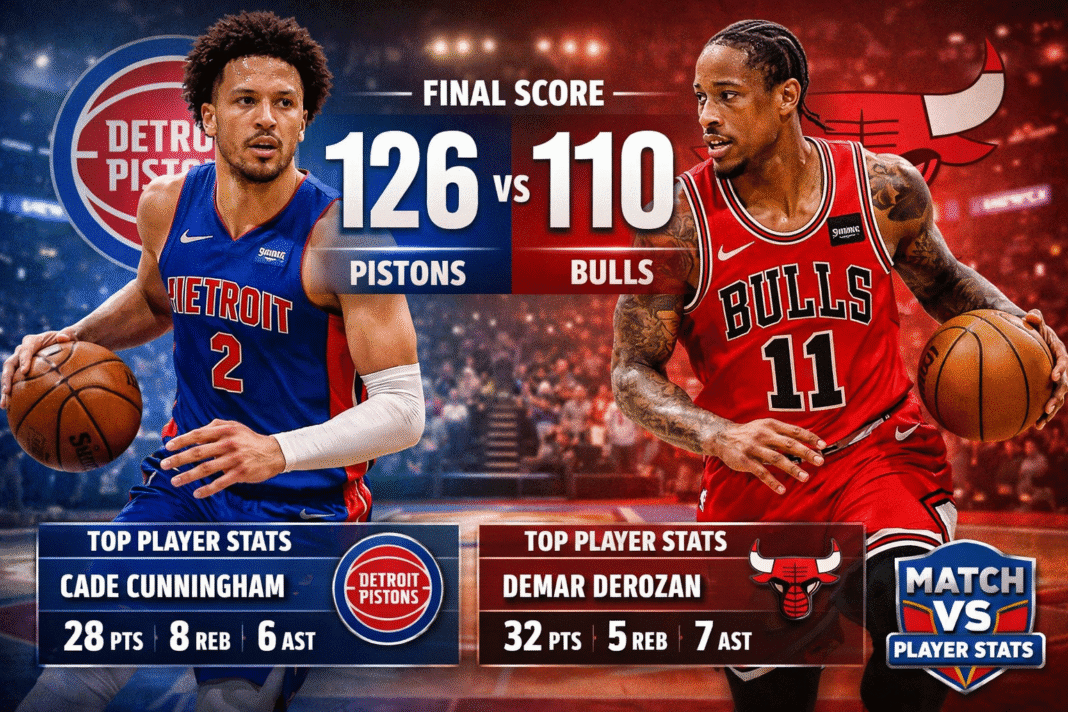
Detroit Pistons vs Chicago Bulls match player stats tell the full story here — the Pistons rolled into Chicago and left with a commanding 126–110 win, fueled by Cade Cunningham’s playmaking masterclass (18 pts, 13 assists, 9 rebounds) and a relentless paint attack that buried the Bulls from the inside out. Josh Giddey led Chicago with 27 points in a losing effort, but Detroit’s depth, ball movement, and third-quarter explosion were simply too much to overcome.
Table of contents
- Final Score Snapshot
- Detroit Pistons vs Chicago Bulls — Full Player Box Score
- Team Stats Head to Head
- Advanced Metrics
- What Actually Happened — Game Breakdown
- Shooting Breakdown — Where Each Team Scored
- The Turnover Problem That Sank Chicago
- Key Individual Performances
- Where This Leaves Both Teams
- Final Thoughts
Final Score Snapshot
| Team | Q1 | Q2 | Q3 | Q4 | Final |
|---|---|---|---|---|---|
| Detroit Pistons | 28 | 25 | 44 | 29 | 126 |
| Chicago Bulls | 30 | 20 | 26 | 34 | 110 |
Detroit’s third quarter was the statement. They outscored the Bulls 44–26 in that single frame, turning a tight game into a blowout.
Detroit Pistons vs Chicago Bulls — Full Player Box Score
Detroit Pistons Player Stats
| Player | POS | PTS | REB | AST | STL | BLK | FG% | 3P% | +/- |
|---|---|---|---|---|---|---|---|---|---|
| Cade Cunningham | G | 18 | 9 | 13 | 1 | 3 | 43.8% | 50.0% | +28 |
| Duncan Robinson | G | 17 | 3 | 2 | 0 | 0 | 41.7% | 50.0% | +11 |
| Paul Reed | F | 15 | 9 | 0 | 1 | 1 | 63.6% | — | -6 |
| Ronald Holland II | F | 9 | 4 | 2 | 2 | 0 | 60.0% | — | +5 |
| Ausar Thompson | F | 8 | 3 | 8 | 3 | 0 | 33.3% | — | +21 |
| Caris LeVert | G | 7 | 0 | 2 | 0 | 2 | 28.6% | 50.0% | +5 |
| Marcus Sasser | G | 3 | 0 | 1 | 0 | 0 | 100% | 100% | -2 |
| Javonte Green | G | 2 | 3 | 1 | 0 | 0 | 100% | — | +5 |
Bench Points: 39 | Team Assists: 34 | Rebounds: 60 | Turnovers: 14
Chicago Bulls Player Stats
| Player | POS | PTS | REB | AST | STL | BLK | FG% | 3P% | +/- |
|---|---|---|---|---|---|---|---|---|---|
| Josh Giddey | G | 27 | 6 | 3 | 0 | 1 | 62.5% | 62.5% | -7 |
| Matas Buzelis | G | 15 | 6 | 3 | 2 | 6 | 50.0% | 28.6% | -19 |
| Jalen Smith | F | 15 | 7 | 2 | 0 | 3 | 83.3% | 75.0% | -3 |
| Isaac Okoro | F | 15 | 3 | 3 | 1 | 1 | 41.7% | 50.0% | -18 |
| Guerschon Yabusele | C | 12 | 9 | 8 | 0 | 1 | 42.9% | 50.0% | -13 |
| Tre Jones | G | 7 | 2 | 6 | 2 | 0 | 42.9% | — | -2 |
| Nick Richards | C | 5 | 5 | 0 | 0 | 1 | 33.3% | — | -12 |
| Collin Sexton | G | 2 | 2 | 1 | 2 | 0 | 20.0% | — | +3 |
| Rob Dillingham | G | 2 | 1 | 1 | 1 | 0 | 0% | — | -4 |
Bench Points: 26 | Team Assists: 29 | Rebounds: 52 | Turnovers: 23
Team Stats Head to Head
| Stat | Detroit Pistons | Chicago Bulls |
|---|---|---|
| Points | 126 | 110 |
| Field Goal % | 48.6% | 45.2% |
| 3-Point % | 44.8% | 42.5% |
| Free Throw % | 73.3% | 70.8% |
| Total Rebounds | 60 | 52 |
| Offensive Rebounds | 13 | 8 |
| Assists | 34 | 29 |
| Steals | 12 | 10 |
| Blocks | 6 | 13 |
| Turnovers | 14 | 23 |
| Points in Paint | 68 | 38 |
| Fast Break Points | 20 | 16 |
| Second Chance Points | 26 | 16 |
| Bench Points | 39 | 26 |
| Biggest Lead | +28 | +4 |
| Points Off Turnovers | 28 | 19 |
| Assist/Turnover Ratio | 2.43 | 1.26 |
| Effective FG% | 54.8% | 55.4% |
| True Shooting % | 56.5% | 58.2% |
Advanced Metrics
| Metric | Detroit | Chicago |
|---|---|---|
| Offensive Rating | 111.9 | 100.4 |
| Defensive Rating | 100.4 | 111.9 |
| Possessions | 112.6 | 109.6 |
| Off. Points Per Possession | 1.12 | 1.00 |
| Def. Points Per Possession | 0.98 | 1.15 |
| Team Efficiency Score | 139 | 126 |
Detroit’s offensive rating of 111.9 against a defensive rating of 100.4 is a +11.5 differential. That kind of separation in a single game represents dominant, two-way basketball.
What Actually Happened — Game Breakdown
The Paint Told the Whole Story
One number captures this game: 68 vs 38 in points in the paint. Detroit attacked the rim all night. Paul Reed went 7-of-11 inside for 15 points and 9 rebounds. The Pistons went to the rim 52 times, converted 30 of those at 57.7%. Chicago attempted just 30 rim shots the entire game.
That paint gap of 30 points is nearly the entire margin of victory. Chicago was pushed off the interior, and when you concede the paint that badly, your shooting efficiency elsewhere cannot fully compensate.
Cade Cunningham Was the Engine
13 assists against just 1 turnover. That 13.0 assist-to-turnover ratio for a single game is a statement number. Cunningham controlled the pace, found cutters in the paint, spotted Robinson in the corner, and scored 18 himself with 9 rebounds and 3 blocks. His +28 plus/minus led the team. When he was on the floor, Detroit won by nearly that margin.
For a deeper look at how Cunningham has been performing across recent matchups this season, check out the full Pistons game logs and player stat breakdowns at MatchVsPlayerStats.
Josh Giddey Gave Everything — Chicago Just Couldn’t Keep Up
On the other side, 27 points on 62.5% shooting with 5 made threes from Giddey deserves its own recognition. He was genuinely efficient. But Giddey had 5 turnovers himself, and Chicago as a team gave it away 23 times — resulting in Detroit scoring 28 points off those mistakes alone. You can’t manufacture a 30-point swing and expect any winning effort to survive it.
That Third Quarter Changed Everything
At halftime: Detroit 53, Chicago 50. Tight game. Then Detroit went out and scored 44 points in the third quarter.
They ran, attacked second chances, forced turnovers, and went 30-for-52 from the rim across the entire game. By Q4, Chicago needed a miracle and got a competitive 34-point quarter instead — too little, too late.
What drove the Q3 explosion:
- Ausar Thompson pushed the pace hard — 6 fast-break points, 3 steals for the game, and a +21 plus/minus
- Detroit’s bench completely took over — 39 total bench points vs Chicago’s 26
- Chicago’s turnovers compounded at the worst moment, handing Detroit one easy score after another
Matas Buzelis Blocked Everything — But Still Lost
Six blocks from a forward is a legitimately rare performance. Buzelis disrupted, contested, and competed defensively. But his -19 plus/minus reflected the team-wide collapse around those moments of individual brilliance. He’s clearly developing into a two-way piece Chicago can build around — this game just wasn’t his team’s night.
Shooting Breakdown — Where Each Team Scored
Detroit Pistons
| Source | Points | Att | Made | Pct |
|---|---|---|---|---|
| Points in Paint | 68 | 70 | 34 | 48.6% |
| Fast Break | 20 | 16 | 9 | 56.3% |
| Second Chance | 26 | 18 | 11 | 61.1% |
| Off Turnovers | 28 | — | — | — |
| Bench | 39 | — | — | — |
Chicago Bulls
| Source | Points | Att | Made | Pct |
|---|---|---|---|---|
| Points in Paint | 38 | 39 | 19 | 48.7% |
| Fast Break | 16 | 12 | 6 | 50.0% |
| Second Chance | 16 | 12 | 7 | 58.3% |
| Off Turnovers | 19 | — | — | — |
| Bench | 26 | — | — | — |
Detroit didn’t just win one category. They dominated every secondary scoring avenue: paint, transition, second chances, off turnovers, and bench production. That’s complete team basketball.
The Turnover Problem That Sank Chicago
Detroit was clean: 14 turnovers at a 2.43 assist-to-turnover ratio. Chicago: 23 turnovers at a 1.26 ratio. That’s a dramatic difference in ball security, and it resulted in a 28 vs 19 disparity in points off turnovers. The combined impact of those extra mistakes was worth roughly 9 additional points for Detroit — points they simply didn’t have to earn through offense.
Here’s the interesting wrinkle: Chicago’s effective FG% (55.4%) and true shooting % (58.2%) were both slightly better than Detroit’s when they actually got shots off. The Bulls were not shooting poorly. They were just giving the ball away too often and too carelessly.
Key Individual Performances
Cade Cunningham (DET): 18 points, 9 rebounds, 13 assists, 3 blocks, 1 turnover. A double-double performance with defensive impact and the cleanest playmaking ratio on the court. This is what All-Star caliber looks like.
Josh Giddey (CHI): 27 points on 62.5% FG with five threes. The game leader for Chicago who had no real support from the team structure around him.
Duncan Robinson (DET): 5-of-10 from three for 17 points and a +11 rating. His corner shooting created space for everything Detroit ran in the paint.
Paul Reed (DET): 15 points and 9 rebounds on 63.6% shooting. One of the more quietly dominant interior performances of the night.
Ausar Thompson (DET): Only 8 points but 8 assists, 3 steals, and a +21 plus/minus. His two-way impact at that plus/minus level is often more valuable than his raw scoring line.
Jalen Smith (CHI): 15 points on 83.3% shooting with 3 blocks. A model of shooting efficiency in a losing cause.
Guerschon Yabusele (CHI): 12 points and 8 assists from center is a uniquely versatile stat line. He gave Chicago some playmaking they didn’t get from other spots.
Where This Leaves Both Teams
Detroit is playing winning basketball with purpose. Their paint dominance, bench depth (39 pts), and elite ball movement (34 assists at a 2.43 A/TO ratio) makes them a genuinely difficult matchup for any Eastern Conference team.
For Chicago, the 23 turnovers and the paint getting carved up for 68 points are the two things the coaching staff will address immediately. Giddey is capable of big offensive outputs. Buzelis is becoming a real defensive presence. But the foundation around them needs to be more disciplined and more physical inside.
Final Thoughts
The Detroit Pistons vs Chicago Bulls match player stats from February 21, 2026 deliver a clear verdict: Detroit was the better, more complete team. Cade Cunningham conducted a masterclass in playmaking and efficiency. Chicago’s Josh Giddey gave it everything he had in a 27-point performance that simply wasn’t enough. The Pistons’ third-quarter run of 44 points sealed it before Chicago could respond. Numbers first, story second — and both tell the same story on this night.