
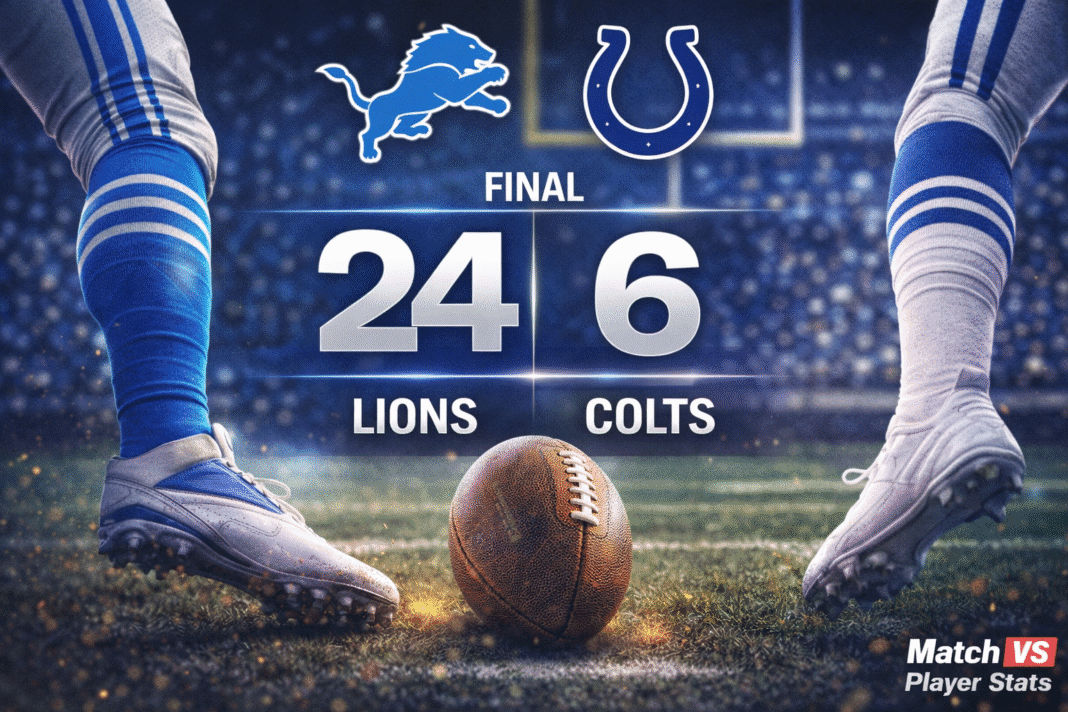
The Detroit Lions vs Colts match player stats tell the story of a dominant defensive performance that pushed Detroit to 10-1 for the first time since 1934. The Lions crushed Indianapolis 24-6 at Lucas Oil Stadium, with Jahmyr Gibbs recording 90 rushing yards and 2 touchdowns while the defense kept the Colts out of the end zone all afternoon.
Table of contents
- Final Score and Key Contributors
- Passing Statistics: Tale of Two Quarterbacks
- Rushing Attack: Lions Ground Game Dominates
- Receiving Corps Production
- Defensive Battle: Lions Lock Down Colts
- Special Teams and Field Position
- Game Flow and Scoring Summary
- Team Statistics Breakdown
- Injury Report and Game Notes
- Coaching Perspectives
- Critical Moments That Shaped the Outcome
- Historical Context and Playoff Implications
- Looking Ahead
- Advanced Metrics and Performance Analysis
- Final Thoughts on Detroit Lions vs Colts Match Player Stats
Final Score and Key Contributors
Detroit Lions 24, Indianapolis Colts 6
The road victory extended Detroit’s winning streak to nine games while dropping Indianapolis to 5-7 on the season. Gibbs led the ground attack with 21 carries for 90 yards and 2 scores, while David Montgomery added 37 yards and a touchdown on 8 attempts before leaving with a shoulder injury. Jared Goff managed the game efficiently with 269 passing yards on 26-of-36 completion.
On the other side, Anthony Richardson struggled with accuracy, completing just 11-of-28 passes for 172 yards, though he did lead the Colts in rushing with 61 yards on 10 carries.
Passing Statistics: Tale of Two Quarterbacks
| Player | Team | C/ATT | Yards | TD | INT | Sacks | QBR | Passer Rating |
|---|---|---|---|---|---|---|---|---|
| Jared Goff | DET | 26/36 | 269 | 0 | 0 | 3-16 | 38.9 | 93.4 |
| Anthony Richardson | IND | 11/28 | 172 | 0 | 0 | 0-0 | 38.8 | 60.4 |
Goff connected with six different receivers, spreading the ball around effectively. His completion percentage of 72.2% kept the chains moving throughout the contest. Meanwhile, Richardson’s 39.3% completion rate told the story of Indianapolis’ offensive struggles.
The passing game breakdown reveals Detroit’s balanced attack versus Indianapolis’ inability to establish rhythm through the air. Goff’s efficiency kept the Lions in control while Richardson’s inconsistency left the Colts constantly fighting uphill.
Rushing Attack: Lions Ground Game Dominates
| Player | Team | Carries | Yards | Average | TD | Long |
|---|---|---|---|---|---|---|
| Jahmyr Gibbs | DET | 21 | 90 | 4.3 | 2 | 17 |
| David Montgomery | DET | 8 | 37 | 4.6 | 1 | 13 |
| Anthony Richardson | IND | 10 | 61 | 6.1 | 0 | 17 |
| Jonathan Taylor | IND | 11 | 35 | 3.2 | 0 | 14 |
| Craig Reynolds | DET | 1 | 6 | 6.0 | 0 | 6 |
The Lions accumulated 137 rushing yards to Indianapolis’ 96, controlling the tempo and time of possession. Gibbs’ first touchdown extended Detroit’s NFL record to 25 consecutive games with a rushing touchdown, including playoffs. He became just the third Lions player to record 1,000 scrimmage yards and 10 touchdowns in each of his first two professional seasons, joining Hall of Famers Billy Sims and Barry Sanders.
Montgomery’s 6-yard touchdown spin into the end zone in the second quarter gave Detroit a 14-6 halftime advantage that proved insurmountable.
Receiving Corps Production
Detroit Lions Receiving
| Player | Receptions | Targets | Yards | Average | TD | Long |
|---|---|---|---|---|---|---|
| Amon-Ra St. Brown | 6 | 7 | 62 | 10.3 | 0 | 15 |
| Jameson Williams | 5 | 7 | 64 | 12.8 | 0 | 21 |
| Tim Patrick | 4 | 4 | 55 | 13.8 | 0 | 27 |
| David Montgomery | 3 | 3 | 36 | 12.0 | 0 | 16 |
| Brock Wright | 2 | 2 | 24 | 12.0 | 0 | 16 |
| Sam LaPorta | 3 | 6 | 19 | 6.3 | 0 | 9 |
| Jahmyr Gibbs | 3 | 3 | 9 | 3.0 | 0 | 8 |
Indianapolis Colts Receiving
| Player | Receptions | Targets | Yards | Average | TD | Long |
|---|---|---|---|---|---|---|
| Michael Pittman Jr. | 6 | 7 | 96 | 16.0 | 0 | 30 |
| Alec Pierce | 1 | 4 | 39 | 39.0 | 0 | 39 |
| Josh Downs | 3 | 7 | 27 | 9.0 | 0 | 11 |
| Adonai Mitchell | 1 | 3 | 10 | 10.0 | 0 | 10 |
Pittman carried the Colts receiving attack with 96 yards, but the lack of touchdown production reflected Indianapolis’ red zone woes. Pierce’s 39-yard catch provided a spark, yet the offense couldn’t capitalize when it mattered most.
St. Brown and Williams gave Goff reliable targets all afternoon, with seven different Lions hauling in passes. The distribution kept Indianapolis’ defense guessing and unable to key on any single threat.
Defensive Battle: Lions Lock Down Colts
Detroit Lions Defense
| Player | Total Tackles | Solo | Sacks | TFL | PD | QB Hits |
|---|---|---|---|---|---|---|
| Jack Campbell | 9 | 5 | 0 | 0 | 2 | 0 |
| Malcolm Rodriguez | 8 | 7 | 0 | 0 | 0 | 0 |
| Brian Branch | 4 | 3 | 0 | 0 | 0 | 0 |
| Kerby Joseph | 4 | 2 | 0 | 0 | 0 | 0 |
| Kindle Vildor | 3 | 2 | 0 | 0 | 0 | 0 |
| DJ Reader | 1 | 1 | 0 | 1 | 0 | 2 |
| Za’Darius Smith | 1 | 1 | 0 | 0 | 0 | 2 |
Indianapolis Colts Defense
| Player | Total Tackles | Solo | Sacks | TFL | PD | QB Hits |
|---|---|---|---|---|---|---|
| Nick Cross | 14 | 6 | 0 | 2 | 0 | 0 |
| Zaire Franklin | 13 | 8 | 1 | 1 | 0 | 1 |
| E.J. Speed | 11 | 6 | 0 | 0 | 0 | 0 |
| DeForest Buckner | 7 | 2 | 1 | 1 | 0 | 2 |
| Samuel Womack III | 7 | 2 | 0 | 0 | 1 | 0 |
| Laiatu Latu | 4 | 2 | 1 | 1 | 0 | 2 |
| Dayo Odeyingbo | 4 | 2 | 0 | 2 | 0 | 2 |
Jack Campbell led the Lions with 9 tackles, continuing his impressive sophomore campaign. The defense recorded 6 quarterback hits and held the Colts offense to just 268 total yards.
Detroit’s defense has now gone 10 quarters without allowing a touchdown, showcasing a physical style that complements their explosive offense. The unit forced the Colts into two field goal attempts in the red zone, with Indianapolis converting just 0-of-2 red zone touchdown opportunities.
Franklin led all tacklers with 13 stops while adding a sack on Goff. Buckner and Latu each recorded sacks for Indianapolis, but the pass rush couldn’t generate enough pressure to disrupt Detroit’s rhythm.
Special Teams and Field Position
Kicking
| Player | Team | FG | Percentage | Long | XP | Points |
|---|---|---|---|---|---|---|
| Jake Bates | DET | 1/1 | 100.0 | 56 | 3/3 | 6 |
| Matt Gay | IND | 2/2 | 100.0 | 29 | 0/0 | 6 |
Bates connected on a 56-yard field goal, while Gay made both of his attempts from 27 and 29 yards. The difference? Detroit found the end zone three times while Indianapolis settled for short field goals.
Punting
| Player | Team | Punts | Yards | Average | TB | Inside 20 | Long |
|---|---|---|---|---|---|---|---|
| Jack Fox | DET | 4 | 192 | 48.0 | 0 | 4 | 60 |
| Rigoberto Sanchez | IND | 6 | 317 | 52.8 | 0 | 2 | 62 |
Fox pinned the Colts inside their own 20-yard line four times, flipping field position in Detroit’s favor. The Lions’ special teams execution provided another edge in the contest.
Game Flow and Scoring Summary
First Quarter
- IND: Matt Gay 27-yard FG (3-0)
Second Quarter
- DET: Jahmyr Gibbs 1-yard TD run (7-3)
- IND: Matt Gay 29-yard FG (7-6)
- DET: David Montgomery 6-yard TD run (14-6)
Third Quarter
- DET: Jahmyr Gibbs 5-yard TD run (21-6)
Fourth Quarter
- DET: Jake Bates 56-yard FG (24-6)
Indianapolis started hot, driving inside the Lions’ 5-yard line on the opening possession but settling for a field goal. That pattern repeated throughout the afternoon as red zone inefficiency doomed the Colts.
Detroit took control in the second quarter with touchdowns on consecutive possessions. Gibbs punched in a 1-yard score, and Montgomery followed with a spinning 6-yard touchdown run that gave the Lions a 14-6 halftime lead.
The second half belonged entirely to Detroit. The defense pitched a shutout while the offense added 10 more points, including Gibbs’ second touchdown of the day.
Team Statistics Breakdown
| Category | Detroit | Indianapolis |
|---|---|---|
| First Downs | 26 | 11 |
| Total Yards | 390 | 268 |
| Total Plays | 72 | 49 |
| Yards Per Play | 5.4 | 5.5 |
| Passing Yards | 253 | 172 |
| Rushing Yards | 137 | 96 |
| Time of Possession | 37:01 | 22:59 |
| Third Down Conversions | 9/15 (60.0%) | 3/12 (25.0%) |
| Fourth Down Conversions | 0/1 (0.0%) | 0/1 (0.0%) |
| Red Zone Efficiency | 3/4 (75.0%) | 0/2 (0.0%) |
| Penalties | 5-45 | 10-75 |
| Turnovers | 0 | 0 |
The Lions dominated time of possession by nearly 15 minutes, controlling the game’s tempo through efficient offense and strong defense. Detroit’s 60% third down conversion rate kept drives alive while Indianapolis managed just 25%, constantly facing third and long situations.
Red zone execution made the difference. Detroit scored touchdowns on 3-of-4 trips inside the 20, while Indianapolis came away empty on both attempts. The Colts’ 10 penalties for 75 yards repeatedly stalled promising drives and gave Detroit favorable field position.
Injury Report and Game Notes
The Lions suffered multiple injuries during a rough third quarter. Receiver Kalif Raymond (foot), left tackle Taylor Decker (right leg), and Montgomery (shoulder) all left the game in quick succession. Raymond and Montgomery did not return, while Decker managed to come back. Cornerback Carlton Davis II departed early in the fourth quarter with an apparent left knee injury.
Indianapolis entered the game without left tackle Bernhard Raimann (knee), forcing the Colts to use three rookie offensive linemen. Receivers Ashton Dulin (ankle) and Josh Downs (shoulder) both left during the second half, though Downs returned while Dulin did not.
The Lions improved to 6-0 on the road this season, marking their best start to a campaign since relocating to Detroit in 1934. They own the NFL’s longest active winning streak at nine games.
Gibbs and Montgomery have now scored touchdowns in the same game nine times during their partnership, establishing one of the league’s most productive backfield duos.
Coaching Perspectives
Detroit head coach Dan Campbell addressed the defensive dominance after the game.
“This is, whatever it is, 10 quarters without allowing a touchdown and the three last games in the second half we’re not allowing it,” Campbell said. “We talk about it all the time, limiting points, play physical style, shut down the run, we were able to do that.”
Campbell praised his team’s road performance and identity.
“Those players, we’ve been around each other long enough, they’ve been around each other to know exactly what we’re looking for,” Campbell said. “We have an identity about us. We know the critical factors as they pertain to winning, and those guys take that stuff serious.”
Indianapolis coach Shane Steichen expressed frustration with his team’s red zone failures.
“We’ve got to take advantage of our opportunities,” Colts coach Shane Steichen said. “This league comes down to inches, it comes down to yards and you’ve got to take advantage of those opportunities. We’ve had issues down in the red zone and you have to look at the tape and clean it up.”
Critical Moments That Shaped the Outcome
Third Quarter Fumble Recovery
With just over six minutes remaining in the third quarter, Detroit faced first and 10 at their own 48-yard line. Goff was hit while attempting to throw and fumbled, with the ball bouncing around before Montgomery recovered at the Lions’ 45. Two plays later, Goff converted third and 9 with a 12-yard completion to St. Brown, and Detroit eventually scored their third touchdown to take a two-score lead.
Had Indianapolis recovered that fumble at midfield, the game’s complexion could have changed dramatically. Instead, Detroit’s offense responded with composure and extended their advantage.
Opening Drive Field Goal
Richardson took the Colts inside the Lions’ 5-yard line on the game’s opening series, yet Indianapolis had to settle for a 27-yard field goal. That early failure to capitalize on excellent field position set the tone for the Colts’ afternoon. Red zone execution separated the teams throughout the contest.
Second Quarter Touchdown Runs
Detroit’s back-to-back touchdown drives in the second quarter turned a 3-0 deficit into a 14-6 halftime lead. Gibbs’ 1-yard score came on the Lions’ second series, and after the Colts answered with another field goal, Montgomery’s 6-yard touchdown run gave Detroit breathing room. The defense ensured those 14 points would be enough.
Historical Context and Playoff Implications
The victory pushed Detroit to 10-1 for the first time since 1934, their inaugural season in the Motor City after relocating from Portsmouth, Ohio. The Lions have built the NFC’s best record while establishing themselves as legitimate Super Bowl contenders.
Their nine-game winning streak represents the franchise’s longest since 1934, and their 6-0 road record matches the best start away from home in team history. Detroit has scored 30 or more points in five of their last seven games while the defense has allowed just two second-half touchdowns over their last three contests.
The Lions’ balanced attack features the NFL’s second-ranked offense at 33.2 points per game entering Week 12. Goff ranks fourth in the league with 20 touchdown passes through 10 games, while the rushing tandem of Gibbs and Montgomery provides consistent production.
Indianapolis dropped to 5-7 and faces an uphill battle to reach the playoffs. The Colts have lost four of their last five games, with red zone inefficiency plaguing the offense. Richardson shows flashes of his immense potential but struggles with consistency, completing just 48.5% of his passes on the season entering this contest.
The Colts’ defense has played well enough to keep games competitive, but the offense’s inability to finish drives with touchdowns has cost Indianapolis multiple victories during this losing stretch.
Looking Ahead
Detroit hosted the Chicago Bears on Thanksgiving Day in their traditional holiday game, looking to extend their winning streak to 10 games. The Lions controlled their playoff destiny with the NFC’s best record and aimed to secure home-field advantage throughout the postseason.
Indianapolis visited the New England Patriots the following Sunday, seeking to salvage their playoff hopes with a must-win game against a struggling opponent. The Colts needed to address their red zone issues quickly or risk seeing their season slip away.
Advanced Metrics and Performance Analysis
The Lions’ efficiency on third down (60%) compared to Indianapolis’ struggles (25%) demonstrated Detroit’s ability to sustain drives. When facing third and manageable situations, Goff consistently found open receivers or handed off to his talented running backs for crucial conversions.
Indianapolis faced far too many third and long situations, putting Richardson in difficult positions to make plays. The Colts’ offensive line struggled to create consistent push in the running game, allowing Detroit’s front seven to pin their ears back on obvious passing downs.
Detroit’s defense generated 6 quarterback hits despite recording zero sacks, maintaining pressure on Richardson throughout the afternoon. The constant harassment forced hurried throws and contributed to his poor completion percentage.
The Lions’ time of possession advantage (37:01 to 22:59) kept Indianapolis’ defense on the field for extended periods. Fresh legs on offense allowed Detroit to maintain their physical running game late while the Colts’ tired defense wore down.
Final Thoughts on Detroit Lions vs Colts Match Player Stats
The detroit lions vs colts match player stats reveal a complete team victory for Detroit, with contributions across all three phases. Gibbs’ two touchdown performance, Goff’s efficient passing, and the defense’s shutout of Indianapolis’ offense in the second half combined to produce a convincing road victory.
Detroit’s championship aspirations look increasingly realistic as they roll through the schedule with a balanced attack and suffocating defense. Meanwhile, Indianapolis must fix their red zone execution issues quickly if they hope to remain in the playoff picture as the season enters its final stretch.
For comprehensive player statistics and match analysis across all NFL games, visit MatchVsPlayerStats.com for detailed breakdowns and historical comparisons.


