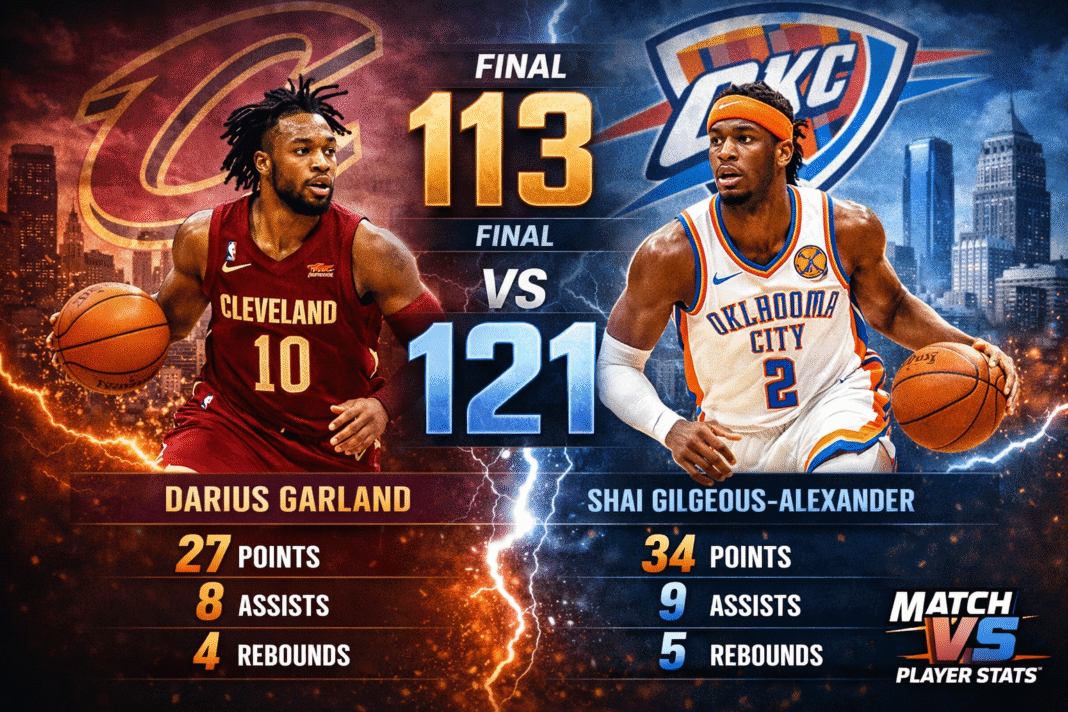
The Cleveland Cavaliers vs Oklahoma City Thunder match player stats from February 22, 2026 tell one clear story: Oklahoma City buried Cleveland in the first quarter and never looked back. OKC won 121-113 at Paycom Center, with Isaiah Joe dropping 22 points off the bench, Chet Holmgren posting a double-double (17 pts, 15 reb), and three Cavaliers hitting 20 points each in a losing effort. Cleveland’s Donovan Mitchell, Sam Merrill, and James Harden each finished with 20 points, but it wasn’t close to enough.
Table of contents
- The Scoreboard and Quarter-by-Quarter Breakdown
- OKC Thunder Player Stats vs Cleveland Cavaliers
- Cleveland Cavaliers Player Stats vs OKC Thunder
- Head-to-Head Team Stats Comparison
- Isaiah Joe’s Breakout Performance
- Chet Holmgren’s Double-Double Anchored OKC Defensively
- Mitchell, Merrill, and Harden: Three 20-Point Performances Weren’t Enough
- Where Cleveland Lost the Game
- This Was a Rematch Scenario
- Advanced Shooting Efficiency Breakdown
- Final Takeaways
- Full Season Context: Where This Fits for Both Teams
The Scoreboard and Quarter-by-Quarter Breakdown
Before we dig into the player-level numbers, here’s how the scoring played out quarter by quarter.
| Quarter | OKC Thunder | CLE Cavaliers |
|---|---|---|
| Q1 | 40 | 25 |
| Q2 | 24 | 30 |
| Q3 | 25 | 31 |
| Q4 | 32 | 27 |
| Final | 121 | 113 |
That Q1 score says it all. OKC came out of the gates swinging and put up 40 points in the first 12 minutes. Cleveland actually won the next three quarters combined, but a 15-point deficit after one frame is a mountain in the NBA. The Cavs mounted some pressure in Q2 and Q3 but could never fully close the gap, and OKC locked it down late.
OKC’s biggest lead in the game reached 23 points. Cleveland’s biggest lead? 1 point. That context alone tells you how lopsided this contest really was.
OKC Thunder Player Stats vs Cleveland Cavaliers
OKC Individual Box Score
| Player | POS | PTS | REB | AST | STL | BLK | FG | 3PT | FT | +/- |
|---|---|---|---|---|---|---|---|---|---|---|
| Isaiah Joe | G | 22 | 2 | 3 | 5 | 0 | 6/13 (46.2%) | 6/11 (54.5%) | 4/4 | +14 |
| Chet Holmgren | F | 17 | 15 | 4 | 1 | 3 | 5/14 (35.7%) | 1/4 | 6/9 | +17 |
| Isaiah Hartenstein | C | 13 | 7 | 4 | 0 | 0 | 6/6 (100%) | 0/0 | 1/4 | +23 |
| Luguentz Dort | F | 12 | 3 | 2 | 2 | 0 | 5/11 (45.5%) | 2/6 | 0/2 | +1 |
| Jared McCain | G | 10 | 3 | 1 | 1 | 0 | 3/7 (42.9%) | 2/3 | 2/2 | -2 |
| Jaylin Williams | F | 10 | 3 | 0 | 0 | 1 | 3/6 (50.0%) | 3/5 (60%) | 1/2 | -17 |
| Kenrich Williams | G-F | 8 | 2 | 1 | 0 | 0 | 3/3 (100%) | 2/2 (100%) | 1/2 | -4 |
| Aaron Wiggins | G | 7 | 3 | 4 | 0 | 0 | 3/7 (42.9%) | 1/2 | 0/0 | -2 |
Note: Shai Gilgeous-Alexander did not appear in the box score data for this game.
OKC Team Shooting and Advanced Stats
| Category | OKC Thunder |
|---|---|
| Field Goal % | 48.8% |
| 3-Point % | 51.2% |
| Free Throw % | 64.0% |
| Total Rebounds | 50 |
| Assists | 32 |
| Turnovers | 16 |
| Steals | 12 |
| Points in Paint | 40 |
| Bench Points | 37 |
| Fast Break Points | 17 |
| Second Chance Points | 17 |
| Points Off Turnovers | 31 |
| Effective FG% | 61.0% |
| True Shooting% | 62.4% |
| Offensive Rating | 121.0 |
| Biggest Lead | 23 |
That 51.2% from three is the number that stings. OKC went 21-of-41 from downtown. When you’re making threes at that rate, most NBA teams are going to struggle to keep pace.
Isaiah Hartenstein going a perfect 6-for-6 from the field with 13 points and 7 rebounds in 23 minutes? That’s the kind of efficiency that flows through an entire offense. His paint dominance gave OKC 12 of their 40 points in the paint off his contributions alone.
Cleveland Cavaliers Player Stats vs OKC Thunder
CLE Individual Box Score
| Player | POS | PTS | REB | AST | STL | BLK | FG | 3PT | FT | +/- |
|---|---|---|---|---|---|---|---|---|---|---|
| Donovan Mitchell | G | 20 | 7 | 5 | 2 | 0 | 9/19 (47.4%) | 0/6 | 2/3 | -1 |
| Sam Merrill | G | 20 | 3 | 0 | 0 | 0 | 7/12 (58.3%) | 6/10 (60%) | 0/0 | +6 |
| James Harden | G | 20 | 5 | 9 | 1 | 1 | 8/14 (57.1%) | 3/7 | 1/2 | -13 |
| Evan Mobley | F | 15 | 2 | 1 | 1 | 0 | 6/11 (54.5%) | 1/4 | 2/2 | -3 |
| Dennis Schroder | G | 11 | 4 | 7 | 1 | 1 | 3/9 (33.3%) | 1/2 | 4/4 | -3 |
| Keon Ellis | G | 9 | 1 | 3 | 2 | 0 | 4/7 (57.1%) | 1/4 | 0/0 | 0 |
| Jaylon Tyson | G-F | 7 | 4 | 0 | 1 | 0 | 2/7 (28.6%) | 1/4 | 2/2 | -1 |
| Dean Wade | F | 0 | 3 | 1 | 0 | 1 | 0/1 | 0/1 | 0/0 | -13 |
| Nae’Qwan Tomlin | F | 0 | 2 | 0 | 0 | 0 | 0/3 | 0/1 | 0/0 | +3 |
CLE Team Shooting and Advanced Stats
| Category | CLE Cavaliers |
|---|---|
| Field Goal % | 48.3% |
| 3-Point % | 33.3% |
| Free Throw % | 73.7% |
| Total Rebounds | 54 |
| Assists | 28 |
| Turnovers | 17 |
| Steals | 9 |
| Points in Paint | 56 |
| Bench Points | 47 |
| Fast Break Points | 21 |
| Second Chance Points | 8 |
| Points Off Turnovers | 12 |
| Effective FG% | 55.6% |
| True Shooting% | 58.0% |
| Offensive Rating | 110.4 |
| Biggest Lead | 1 |
Cleveland actually dominated in the paint, 56-40 over OKC. They also won the fast break battle 21-17 and grabbed more total rebounds (54-50). On paper, those numbers suggest the Cavs were competitive in most physical categories. But 13/39 from three (33.3%) against OKC’s 21/41 (51.2%) is where the game was decided. That’s a 24-point swing in three-point scoring alone.
Head-to-Head Team Stats Comparison
| Stat Category | OKC Thunder | CLE Cavaliers |
|---|---|---|
| Final Score | 121 | 113 |
| FG Made/Att | 42/86 | 43/89 |
| FG% | 48.8% | 48.3% |
| 3PM/A | 21/41 | 13/39 |
| 3P% | 51.2% | 33.3% |
| FT Made/Att | 16/25 | 14/19 |
| Total Rebounds | 50 | 54 |
| Assists | 32 | 28 |
| Turnovers | 16 | 17 |
| Steals | 12 | 9 |
| Blocks | 4 | 3 |
| Points in Paint | 40 | 56 |
| Bench Points | 37 | 47 |
| Fast Break Pts | 17 | 21 |
| Second Chance Pts | 17 | 8 |
| Points Off Turnovers | 31 | 12 |
| Effective FG% | 61.0% | 55.6% |
| True Shooting% | 62.4% | 58.0% |
| Offensive Rating | 121.0 | 110.4 |
| Defensive Rating | 110.4 | 121.0 |
The points-off-turnovers column is a silent killer. OKC scored 31 points off Cleveland’s 17 turnovers, while the Cavs only got 12 from OKC’s 16 miscues. That 19-point gap right there is bigger than the margin of defeat.
Isaiah Joe’s Breakout Performance
This was a career-defining game for the 26-year-old guard off the OKC bench.
Joe shot 6-for-11 from three and finished with 22 points, 5 steals, and 3 assists coming off the bench. His steal total alone was absurd. Five steals in a single game puts you in elite company for any individual night, and he used nearly every one to spark transition opportunities.
For context on how good 22 points and 5 steals is in a single game, the NBA season average for steals sits around 1.5 per game for guards. Five in one contest is a performance-level anomaly. Joe’s 74.5% true shooting percentage for the night reflected a player who was dialed in from start to finish.
This kind of showing for Isaiah Joe is exactly the kind of deep dive you can track regularly at matchvsplayerstats.com alongside full Cavaliers and Thunder season performance logs.
Chet Holmgren’s Double-Double Anchored OKC Defensively
Holmgren finished with 17 points and 15 rebounds, going plus-17 on the night. His 3 blocks were matched by solid rim presence throughout. The 15 rebounds represent a season-level effort from the big man, and his 42.2% defensive rebound rate in this game shows why OKC allows so few second-chance opportunities.
He wasn’t lights-out shooting (5/14 from the field, 35.7%), but the rebounding and the paint defense filled in the gaps. When Holmgren plays at this level on the boards, OKC becomes a genuinely different defensive team.
Mitchell, Merrill, and Harden: Three 20-Point Performances Weren’t Enough
That’s not a sentence you write very often. Cleveland had three players drop 20 points each and still lost by 8.
Donovan Mitchell went 9/19 from the field with 20 points, 7 rebounds, and 5 assists. He got to the rim at will (8/10 on two-point attempts inside, 80% from the paint) but went 0-for-6 from three. For a player of Mitchell’s caliber, getting zero three-pointers on six attempts in a game decided at the perimeter is a rough night.
Sam Merrill was actually the most efficient scorer on either team, shooting 6/10 from three (60%) and ending with a true shooting percentage of 83.3%. His 20 points came in 20 efficient possessions. If Mitchell had even half of Merrill’s three-point luck, this game looks different.
James Harden put up 20 points and 9 assists but coughed up 5 turnovers and committed 2 offensive fouls. With a minus-13 rating on the night, his line reads better than it felt in real time. OKC specifically targeted his ball-handling under pressure, forcing difficult decisions in the half-court.
Where Cleveland Lost the Game
Breaking down the Cleveland Cavaliers vs Oklahoma City Thunder box score beyond just the final numbers, a few patterns stand out.
The Q1 Collapse
Cleveland gave up 40 points in the first quarter alone. OKC shot at an unsustainable clip to open the game, and by the time Cleveland adjusted, they were already chasing. The Cavs went on runs in Q2 and Q3 but the 15-point first-quarter hole was always there in the background.
Three-Point Differential
| Category | OKC | CLE |
|---|---|---|
| 3-Pointers Made | 21 | 13 |
| 3-Point Attempts | 41 | 39 |
| 3-Point% | 51.2% | 33.3% |
| Points from 3 | 63 | 39 |
OKC scored 24 more points from three-point range. That’s a number that overwhelms almost any other advantage you could build elsewhere. The Cavs dominated the paint by 16 points, won fast breaks by 4, yet still lost by 8. The three-ball was the story.
Turnover Exploitation
OKC’s 12 steals leading to 31 points off turnovers is an extraordinary number. That’s nearly two points per steal, and the Thunder ran those transition opportunities with precision. Isaiah Joe (5 steals) and the OKC defense as a whole created chaos that Cleveland never recovered from.
This Was a Rematch Scenario
The two teams had already met earlier in the 2025-26 season, with OKC handing Cleveland a 136-104 loss on January 19. So this February 22 matchup was billed as a potential Cavs response game. Instead, Cleveland fell short again, this time by a narrower 8-point margin but still in clear OKC control for the majority of the contest.
For one of the Eastern Conference’s best teams, back-to-back losses to OKC in the same season is a statement about where the Thunder stand among NBA title contenders in 2026.
Advanced Shooting Efficiency Breakdown
One of the cleaner ways to assess a game like this is through shooting efficiency zones:
| Shooting Zone | OKC (Made/Att) | OKC% | CLE (Made/Att) | CLE% |
|---|---|---|---|---|
| At Rim | 16/26 | 61.5% | 13/18 | 72.2% |
| Mid-Range | 2/4 | 50.0% | 2/5 | 40.0% |
| Three-Point | 21/41 | 51.2% | 13/39 | 33.3% |
Cleveland actually shot better at the rim (72.2% vs 61.5%) but OKC launched 8 more three-point attempts and converted at a dramatically higher rate. The shot selection and execution from three is what separated the two teams in this NBA regular season showdown.
Final Takeaways
A few things worth remembering from this Cleveland Cavaliers vs Oklahoma City Thunder match:
- OKC’s three-point shooting (51.2%) was elite level and unlikely to repeat on most nights. The Thunder made 21 threes against one of the better defensive teams in the East.
- Isaiah Joe’s 22 points and 5 steals was one of the best individual bench performances either team has seen this season.
- Cleveland’s bench actually outscored OKC’s bench 47-37, which is a surprising flip, but the starters got buried in the first quarter before the subs could make a difference.
- Shai Gilgeous-Alexander’s absence (no box score entry) means this Thunder performance came without their primary star. That context makes the result more impressive for OKC and more concerning for Cleveland.
- James Harden’s 5 turnovers in a game this tight is a correctable issue, but it cost the Cavs big-time in points off turnovers.
Full Season Context: Where This Fits for Both Teams
Going into this matchup, Cleveland was one of the East’s top seeds, running a deep rotation and leaning on Mitchell as their primary scoring option. OKC has been one of the NBA’s better teams all season with their youth and depth.
This Thunder win reinforces OKC’s status as a legitimate Western Conference powerhouse, capable of beating elite competition at home. For the Cavaliers, the takeaway is clear: the three-ball has to be better in high-stakes matchups, and ball security against aggressive defensive teams like OKC needs attention before the postseason.
For the full Cleveland Cavaliers vs Oklahoma City Thunder match player stats from this game and ongoing NBA player and team performance tracking through the 2025-26 season, check out matchvsplayerstats.com.