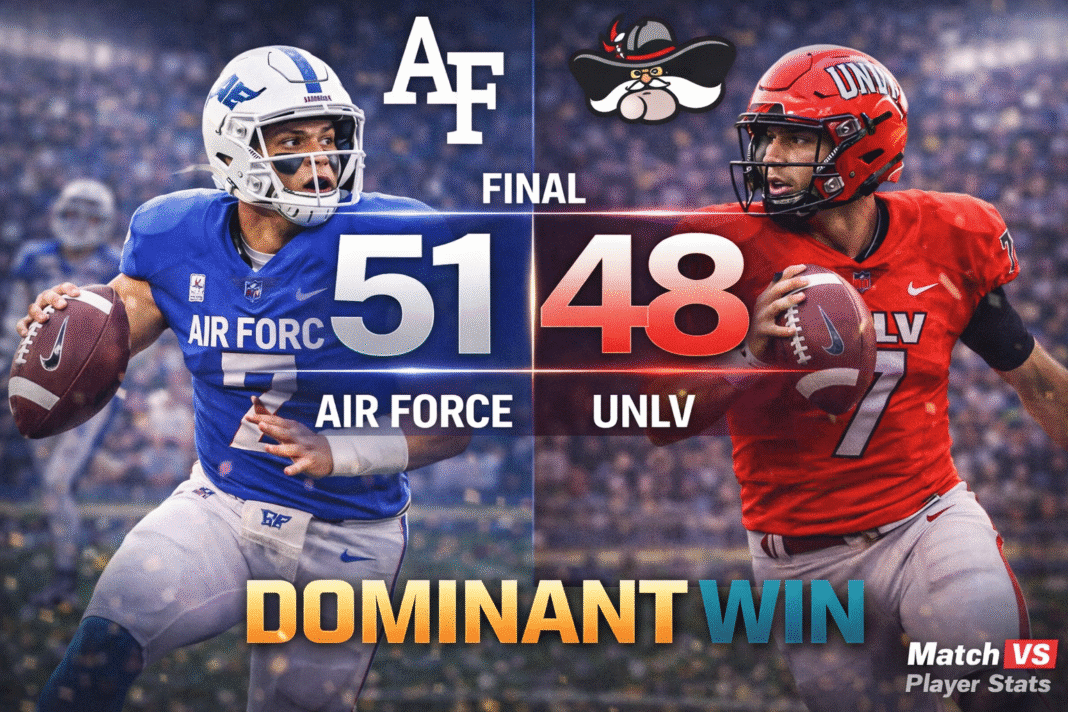
UNLV walked away with a 51-48 victory over Air Force in a shootout that featured 11 lead changes and 1,200 combined yards of offense at Allegiant Stadium. Anthony Colandrea threw for 361 yards and rushed for the game-winning 19-yard touchdown with 36 seconds remaining, while Owen Allen piled up 192 rushing yards and Liam Szarka posted 136 rushing yards with 175 passing yards for the Falcons in the losing effort.
Table of contents
- Offensive Firepower on Full Display
- Ground Game Dominance
- Receiving Corps Production
- Defensive Battle Stats
- Game Flow and Key Moments
- Final Drive Drama
- Team Statistics Breakdown
- Context and Implications
- Historic Performance Numbers
- Air Force Falcons Football vs UNLV Football Match Player Stats: What’s Next
- Statistical Takeaways
Offensive Firepower on Full Display
The October 11, 2025 clash between these Mountain West rivals turned into an offensive showcase that had the 32,932 fans on their feet throughout the nearly four-hour affair. Both offenses were clicking on all cylinders, combining for 99 points and trading haymakers in what became an instant classic.
UNLV Passing Attack Stats
| Player | Completions | Attempts | Yards | Touchdowns | Interceptions | QB Rating |
|---|---|---|---|---|---|---|
| Anthony Colandrea | 20 | 32 | 361 | 1 | 0 | – |
Colandrea’s performance went beyond the numbers. The Virginia transfer connected on a jaw-dropping 86-yard touchdown strike to Daejon Reynolds early in the third quarter that shifted momentum back to the Rebels. That connection alone accounted for nearly a quarter of his passing yardage and showcased the big-play ability that’s made UNLV’s offense so dangerous this season.
Air Force Passing Attack Stats
| Player | Completions | Attempts | Yards | Touchdowns | Interceptions |
|---|---|---|---|---|---|
| Liam Szarka | 10 | 17 | 175 | 1 | 0 |
Szarka’s efficiency through the air complemented his dominant rushing performance. The sophomore quarterback found senior tight end Bruin Fleischmann for a 17-yard touchdown in the third quarter, continuing Fleischmann’s hot streak of four consecutive games with receiving scores.
Ground Game Dominance
UNLV Rushing Stats
| Player | Carries | Yards | Average | Touchdowns | Long |
|---|---|---|---|---|---|
| Jai’Den Thomas | 11 | 88 | 8.0 | 1 | 51 |
| Anthony Colandrea | 7 | 62 | 8.9 | 2 | 19 |
| Keyvone Lee | 2+ | 59+ | – | 1 | – |
Thomas and Lee combined for 147 yards on just 13 carries with two touchdowns between them. Thomas broke off a crucial 51-yard touchdown run in the fourth quarter that gave UNLV a 44-41 lead with under five minutes remaining. The explosive plays kept coming when the Rebels needed them most.
Air Force Rushing Stats
| Player | Carries | Yards | Average | Touchdowns | Long |
|---|---|---|---|---|---|
| Owen Allen | 17 | 192 | 11.3 | 2 | 28 |
| Liam Szarka | 27 | 136 | 5.0 | 2 | 9 |
| Cade Harris | – | 45 | – | 2 | – |
Allen put together a career performance with 192 yards, slashing through the UNLV defense with runs of 28 and 21 yards for touchdowns. His explosive second-quarter performance helped Air Force build a 21-10 lead. Szarka showed his dual-threat abilities, carrying the ball 27 times and scoring twice, including the go-ahead 9-yard touchdown run with 1:13 remaining that temporarily gave the Falcons a 48-44 advantage.
Receiving Corps Production
UNLV Receiving Stats
| Player | Receptions | Yards | Average | Touchdowns | Long |
|---|---|---|---|---|---|
| Daejon Reynolds | 4 | 139 | 34.8 | 1 | 86 |
Reynolds turned his four catches into 139 yards, proving that quality beats quantity every time. His 86-yard score was a thing of beauty, taking advantage of Air Force’s struggling pass defense that entered the game ranked 132nd nationally in passing yards allowed.
Air Force Receiving Stats
| Player | Receptions | Yards | Average | Touchdowns |
|---|---|---|---|---|
| Jonah Dawson | 3 | 79 | 26.3 | 0 |
| Cade Harris | 4 | 46 | 11.5 | 0 |
| Bruin Fleischmann | 2 | 35 | 17.5 | 1 |
Dawson led the Falcons’ receiving corps with 79 yards on three catches, providing consistent chunk plays through the air. Harris contributed both on the ground and through the air, hauling in four passes while also rushing for two touchdowns. Fleischmann’s touchdown catch extended his impressive streak to four games.
Defensive Battle Stats
Tackles Leaders
| Team | Player | Total Tackles | Solo | Assisted |
|---|---|---|---|---|
| Air Force | Blake Fletcher | 10 | 0 | – |
| UNLV | Andrew Powdrell | 13 | 6 | – |
Fletcher led the Falcons defense for the fourth time this season with 10 tackles, but it wasn’t enough to slow down UNLV’s balanced attack. Powdrell paced the Rebels with 13 total stops, including six solo tackles in a performance that showcased his range across the secondary.
Team Defensive Performance
| Category | Air Force | UNLV |
|---|---|---|
| Total Yards Allowed | 597 | 603 |
| Passing Yards Allowed | 368 | 175 |
| Rushing Yards Allowed | 229 | 428 |
| Points Allowed | 51 | 48 |
| Turnovers Forced | 0 | 1 |
| Sacks | 0 | 0 |
Neither defense could get stops when it mattered. The Falcons allowed 597 yards while giving up 368 through the air to Colandrea. UNLV’s defense surrendered 603 yards, with Air Force gashing them for 428 on the ground. The lack of pass rush from both sides allowed quarterbacks to operate comfortably in the pocket all afternoon.
Game Flow and Key Moments
The scoring opened quickly with UNLV striking first on a 3-yard Colandrea touchdown run just over five minutes into the game. Air Force answered with a Cade Harris 5-yard rushing score to knot things at 7-7.
The second quarter belonged to the Falcons’ ground game. Owen Allen ripped off touchdown runs of 21 and 28 yards, sandwiching a UNLV field goal to give Air Force a 21-10 halftime advantage.
Everything changed in the third quarter. UNLV scored two touchdowns in the opening two minutes, including the Reynolds 86-yarder, to grab a 26-21 lead. The teams would swap the lead eight more times the rest of the way.
Fourth Quarter Fireworks
The final period produced 42 points and six lead changes. Every possession felt like it could be the difference. Air Force took a 34-29 lead on a Szarka rushing touchdown, but Lee answered for UNLV with a 2-yard score plus a two-point conversion to make it 37-34 Rebels.
Harris punched in a 4-yard touchdown to put Air Force back ahead 41-37. Thomas countered with his 51-yard house call for a 44-41 UNLV edge. Szarka’s 9-yard score with 1:13 left gave the Falcons their final lead at 48-44.
That set up Colandrea’s heroics. The quarterback scrambled left, found space, and bulldozed into the end zone for the game-winning score with just 36 seconds showing on the clock.
Final Drive Drama
Air Force had one last chance. Szarka led the Falcons down to the UNLV 23-yard line with two ticks left. Jacob Medina trotted out for a 40-yard field goal attempt that would send the game to overtime. The kick sailed wide right, ending Air Force’s comeback hopes and preserving UNLV’s perfect record.
Team Statistics Breakdown
Overall Offensive Stats
| Category | Air Force | UNLV |
|---|---|---|
| Total Yards | 603 | 597 |
| Rushing Yards | 428 | 229 |
| Passing Yards | 175 | 368 |
| First Downs | 32 | 24 |
| Third Down Efficiency | 4-10 (40%) | 5-11 (45%) |
| Fourth Down Efficiency | 3-4 (75%) | 0-1 (0%) |
| Time of Possession | 36:51 | 23:09 |
| Penalties | 7-71 | 9-79 |
| Turnovers | 1 | 0 |
Air Force controlled possession for nearly 37 minutes but couldn’t convert that advantage into a win. The Falcons were aggressive on fourth down, going 3-for-4, while their third-down struggles at 40% left too many drives stalling.
Scoring by Quarter
| Quarter | Air Force | UNLV |
|---|---|---|
| 1st | 7 | 7 |
| 2nd | 14 | 6 |
| 3rd | 7 | 16 |
| 4th | 20 | 22 |
| Final | 48 | 51 |
The fourth quarter explosion of 42 combined points made this game an instant classic. Both teams refused to quit, trading scores in a back-and-forth battle that came down to the final seconds.
Context and Implications
This Mountain West showdown had major implications for both programs. UNLV improved to 6-0 overall and 2-0 in conference play, securing bowl eligibility for the third consecutive season for the first time in program history. The Rebels extended their win streak to seven games dating back to the previous season and remained undefeated for the first time since 1974.
Head coach Dan Mullen praised his team’s resilience, calling the performance evidence of their championship character. The victory at home marked the first time UNLV had beaten Air Force at Allegiant Stadium and their first win over the Falcons at home since 2012.
For Air Force, the loss dropped them to 1-5 overall and 0-4 in the Mountain West. Despite the offensive explosion that produced 603 yards and 48 points, the Falcons couldn’t overcome their defensive struggles. The unit entered the game ranked 130th nationally in scoring defense, allowing 37.8 points per game, and those issues persisted against UNLV’s balanced attack.
Historic Performance Numbers
The 99 combined points set a record for the most ever scored in an Air Force-UNLV matchup, surpassing the previous high of 82 points in 1996. UNLV’s 51 points were the most the Rebels had ever scored against Air Force, topping their 42-point output in a 2006 victory.
The 86-yard touchdown pass from Colandrea to Reynolds was the longest in UNLV history against a conference opponent and the third-longest in program history overall. Only a 94-yard strike in 2017 at Idaho and an 87-yarder in 1977 versus Northern Arizona were longer.
Szarka’s 136 rushing yards marked a career high for the sophomore quarterback, showcasing the dual-threat abilities that have made Air Force’s offense more explosive than in recent years. Allen’s 192-yard performance was also a personal best, demonstrating the Falcons’ ground game prowess even in a losing effort.
Air Force Falcons Football vs UNLV Football Match Player Stats: What’s Next
UNLV’s perfect start positioned them for a showdown with Boise State the following week, while the Rebels looked to continue their historic season. The defensive issues needed addressing if they hoped to sustain success against tougher conference opponents.
Air Force returned home to face Wyoming, searching for answers on the defensive side of the ball. The offense showed it could move the ball and score points, but allowing 51 points wasn’t going to win many games regardless of how well the attack performed.
For fans seeking more college football insights and detailed statistical breakdowns, matchvsplayerstats.com provides comprehensive coverage of games across all levels of competition.
Statistical Takeaways
The air force falcons football vs unlv football match player stats revealed several key trends. UNLV’s ability to create explosive plays, averaging 8.0 yards per carry for Thomas and 8.9 for Colandrea, proved decisive. Air Force’s time of possession advantage couldn’t overcome their defensive shortcomings and critical mistakes in the final minutes.
Both quarterbacks delivered clutch performances, but Colandrea’s game-winning drive will be remembered as the difference. His 361 passing yards combined with 62 rushing yards and three total touchdowns showcased the complete skill set that makes him one of the Mountain West’s most dangerous offensive weapons.
The defensive statistics told a troubling story for both teams. Combined, they allowed 1,200 yards of offense without recording a single sack. The lack of pass rush allowed both quarterbacks to operate freely, contributing to the offensive explosion.
This thriller at Allegiant Stadium provided everything college football fans could want: explosive plays, dramatic momentum swings, clutch performances, and a finish that came down to the final play. The air force falcons football vs unlv football match player stats showed two teams that could move the ball at will but struggled to get critical stops when needed most.