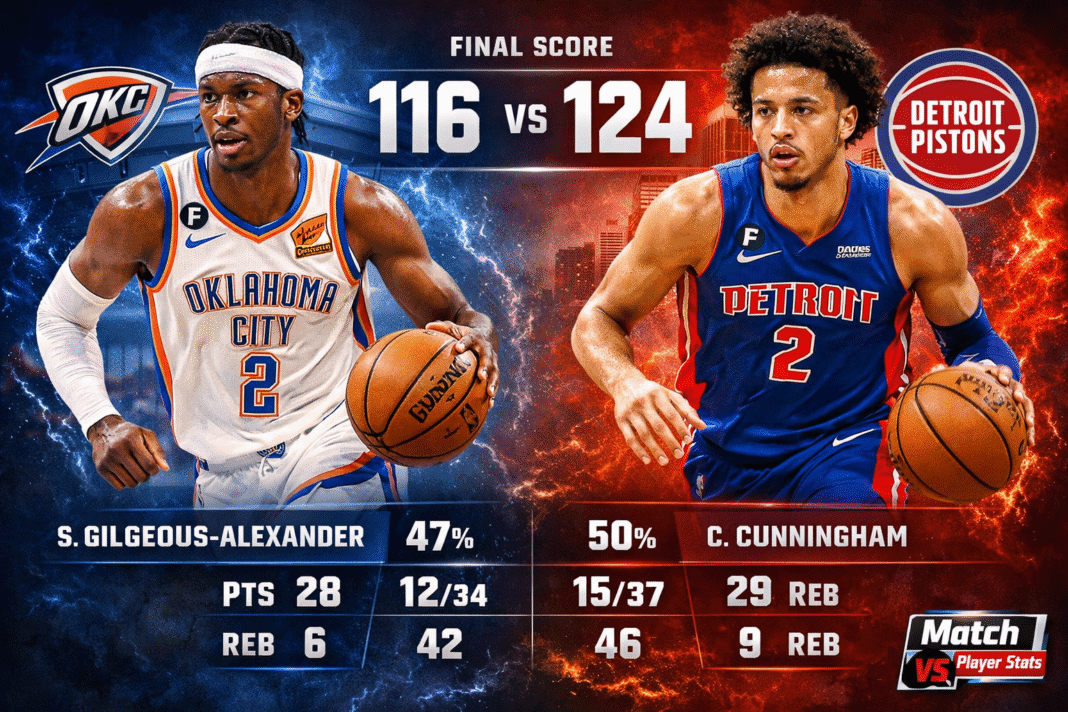
If you came here looking for the full Oklahoma City Thunder vs Detroit Pistons match player stats from February 25, 2026, you are in the right place. Detroit walked into Paycom Center and left with a 124-116 victory over the Western Conference leading Thunder, handing OKC a loss that felt as much about paint domination as it did about Cade Cunningham taking over a game. Jaylin Williams dropped 30 for OKC in a losing effort, but it was not enough to stop a Pistons team that shot 53.9% from the field and won the rebounding battle by a wide margin.
Table of contents
- Quick Look: Final Score and Quarter Breakdown
- Detroit Pistons Player Stats
- OKC Thunder Player Stats
- Team Stats Comparison
- Advanced Stats Snapshot
- How the Game Actually Played Out
- Cade Cunningham and Jalen Duren: The Two That Won It
- Jaylin Williams Gives OKC Everything He Had
- The Paint Story: 70 vs 32
- Shooting Splits: Volume vs Efficiency
- Rebounding and Second Chances
- Turnover Battle and Points Off Turnovers
- What This Result Means for Both Teams
- Player Efficiency Ratings: Who Performed Best on the Night
- Final Word
Quick Look: Final Score and Quarter Breakdown
| Period | Detroit Pistons | OKC Thunder |
|---|---|---|
| Q1 | 22 | 34 |
| Q2 | 36 | 18 |
| Q3 | 36 | 28 |
| Q4 | 30 | 36 |
| Final | 124 | 116 |
OKC won the first quarter by 12 points. Then Detroit outscored them 72-46 over the next two quarters. That 26-point swing in Q2 and Q3 combined is what decided the game. The Thunder tried to claw back in the fourth, outscoring Detroit 36-30, but the deficit was already too large.
Detroit Pistons Player Stats
Starters
| Player | POS | PTS | REB | AST | STL | BLK | FG% | 3P% | FT% | +/- |
|---|---|---|---|---|---|---|---|---|---|---|
| Cade Cunningham | G | 29 | 4 | 13 | 3 | 3 | 68.8% | 60.0% | 100% | +17 |
| Jalen Duren | C | 29 | 15 | 2 | 0 | 1 | 70.6% | — | 71.4% | +12 |
| Ausar Thompson | F | 11 | 4 | 7 | 3 | 2 | 71.4% | — | 25.0% | +15 |
| Duncan Robinson | G | 16 | 3 | 3 | 1 | 0 | 36.4% | 33.3% | 100% | +15 |
| Tobias Harris | F | 4 | 8 | 1 | 0 | 1 | 40.0% | — | — | +2 |
Bench
| Player | POS | PTS | REB | AST | STL | BLK | FG% | +/- |
|---|---|---|---|---|---|---|---|---|
| Paul Reed | F | 8 | 6 | 0 | 0 | 4 | 42.9% | -4 |
| Caris LeVert | G | 9 | 0 | 1 | 0 | 0 | 50.0% | -11 |
| Javonte Green | G | 6 | 4 | 0 | 1 | 1 | 50.0% | +9 |
| Daniss Jenkins | G | 4 | 3 | 0 | 0 | 0 | 33.3% | -7 |
Detroit Bench Total: 35 points
OKC Thunder Player Stats
Starters
| Player | POS | PTS | REB | AST | STL | BLK | FG% | 3P% | FT% | +/- |
|---|---|---|---|---|---|---|---|---|---|---|
| Jaylin Williams | C | 30 | 11 | 4 | 1 | 1 | 64.3% | 50.0% | 100% | -15 |
| Aaron Wiggins | F | 20 | 4 | 6 | 1 | 1 | 37.5% | 28.6% | 85.7% | +4 |
| Jared McCain | G | 20 | 3 | 2 | 0 | 0 | 37.5% | 40.0% | 100% | +4 |
| Kenrich Williams | G-F | 13 | 4 | 0 | 0 | 0 | 50.0% | 66.7% | 100% | -2 |
| Isaiah Joe | G | 3 | 2 | 1 | 1 | 0 | 20.0% | 20.0% | — | -6 |
Bench
| Player | POS | PTS | REB | AST | STL | BLK | FG% | +/- |
|---|---|---|---|---|---|---|---|---|
| Branden Carlson | C | 4 | 4 | 2 | 0 | 0 | 50.0% | +11 |
| Nikola Topic | G | 0 | 2 | 4 | 0 | 0 | — | -11 |
| Brooks Barnhizer | G | 0 | 2 | 0 | 1 | 1 | — | +6 |
| Isaiah Joe | G | 3 | 2 | 1 | 1 | 0 | 20.0% | -6 |
OKC Bench Total: 37 points
Note: Shai Gilgeous-Alexander did not appear in the box score for this game, which is a significant absence for OKC given his role as the team’s primary scorer and engine.
Team Stats Comparison
| Category | Detroit Pistons | OKC Thunder |
|---|---|---|
| Points | 124 | 116 |
| FG Made / Att | 48/89 | 39/96 |
| FG% | 53.9% | 40.6% |
| 3PM / 3PA | 9/27 | 18/49 |
| 3P% | 33.3% | 36.7% |
| FTM / FTA | 19/26 | 20/21 |
| FT% | 73.1% | 95.2% |
| Total Rebounds | 59 | 47 |
| Offensive Rebounds | 16 | 12 |
| Assists | 29 | 28 |
| Steals | 9 | 7 |
| Blocks | 12 | 3 |
| Turnovers | 17 | 14 |
| Points in Paint | 70 | 32 |
| Second Chance Points | 17 | 30 |
| Fast Break Points | 13 | 8 |
| Points Off Turnovers | 16 | 27 |
| Bench Points | 35 | 37 |
| Effective FG% | 59.0% | 50.0% |
| True Shooting% | 61.7% | 55.1% |
| Biggest Lead | +17 | +12 |
Advanced Stats Snapshot
| Category | Detroit | OKC |
|---|---|---|
| Offensive Rating | 122.2 | 108.2 |
| Defensive Rating | 108.2 | 122.2 |
| Possessions | 101.4 | 107.2 |
| Off. Points Per Possession | 1.22 | 1.08 |
| Def. Points Per Possession | 1.14 | 1.16 |
| Team Efficiency Score | 159 | 109 |
| Points in Paint Attempts | 54 | 37 |
| Points in Paint % | 64.8% | 43.2% |
The efficiency gap here is significant. Detroit’s offensive rating of 122.2 was elite level for a single game. OKC’s defense gave up 70 points in the paint, which stands out as the clearest reason they lost despite winning the first quarter.
How the Game Actually Played Out
OKC came out of the gates swinging. They scored 34 points in the first quarter and built a 12-point lead. That kind of start on your home floor should set you up well. But Detroit had a different plan.
The second quarter was a complete reversal. The Pistons outscored OKC 36-18, turning a 12-point deficit into a 2-point lead by halftime. That 18-point swing in one quarter is what changed the game.
What shifted?
- Detroit got Jalen Duren going in the paint early in Q2
- Cade Cunningham started pushing pace in transition
- OKC’s interior defense could not contain Detroit’s size advantage
- The Thunder’s field goal shooting dropped significantly after that hot first quarter
Detroit then kept the foot on the gas in Q3, outscoring OKC again by 8. By the time the fourth quarter started, the Pistons held a comfortable lead and managed it well enough to close out the win.
Cade Cunningham and Jalen Duren: The Two That Won It
This game belonged to two Pistons players.
Cade Cunningham put up 29 points and 13 assists on 68.8% shooting. He had 8 turnovers which is messy, but his efficiency numbers were remarkable. He shot 60% from three, 100% from the line, and his true shooting percentage of 81.6% was borderline historic for a 40-minute performance. The biggest lead Detroit built was 17 points, and Cunningham was at the center of every run that created it.
Jalen Duren was the force that OKC simply could not match. He finished with 29 points and 15 rebounds, shooting 70.6% from the field. He scored 24 of his points in the paint. He went after 21 shot attempts, grabbed 5 offensive boards, and had a +12 plus-minus. For a player still developing into his role, this was a statement game in enemy territory.
Together, Cunningham and Duren combined for 58 points, 19 rebounds, and 15 assists while shooting 69.7% from the floor. That is the kind of production that beats you on the road at a first-place team’s building.
Jaylin Williams Gives OKC Everything He Had
On the losing side, Jaylin Williams was genuinely outstanding. He scored 30 points on 64.3% shooting, grabbed 11 rebounds for a double-double, and went a perfect 7 of 7 from the free throw line. He also hit 5 of 10 from three-point range, showing range that defenders had to respect.
The problem was his minus-15 plus-minus. When Williams was on the floor, Detroit was the better team. That is not entirely on him, but it shows how much the overall defensive breakdown around him affected the final margin.
Aaron Wiggins added 20 points and 6 assists. Jared McCain chipped in 20 more off the bench effectively. OKC had three players scoring 20 or more points. They just could not stop Detroit in the paint.
For a deeper breakdown of how individual player contributions shift game outcomes, matchvsplayerstats.com tracks per-game player data across the full NBA season.
The Paint Story: 70 vs 32
This is the number that tells the whole story.
Detroit scored 70 points in the paint. OKC scored 32.
That is not just a gap. That is a different game being played by both teams. Detroit attempted 54 shots in the paint compared to OKC’s 37. They converted those at 64.8% compared to OKC’s 43.2%.
| Paint Metric | Detroit | OKC |
|---|---|---|
| Points in Paint | 70 | 32 |
| Paint Attempts | 54 | 37 |
| Paint Makes | 35 | 16 |
| Paint FG% | 64.8% | 43.2% |
Duren was the primary reason. He had 12 paint field goals on 16 attempts for 24 of those 70 paint points. Ausar Thompson added 10 paint points. Detroit as a unit attacked the rim with purpose and converted at a rate OKC’s frontcourt could not match.
OKC’s block count was only 3 for the game. Detroit blocked 12. That defensive presence in the paint also matters because it deterred OKC from taking the same aggressive rim attacks Detroit was comfortable making.
Shooting Splits: Volume vs Efficiency
OKC shot more threes. Detroit shot better overall.
| Shooting Category | Detroit | OKC |
|---|---|---|
| Overall FG% | 53.9% | 40.6% |
| Three-Point Makes | 9 | 18 |
| Three-Point Attempts | 27 | 49 |
| Three-Point% | 33.3% | 36.7% |
| Two-Point% | 62.9% | 44.7% |
| Free Throw% | 73.1% | 95.2% |
| Effective FG% | 59.0% | 50.0% |
OKC attempted 49 threes. That volume was partly a necessity since they were getting beaten at the rim and had to find points somewhere. Detroit’s two-point shooting at 62.9% was powered by the paint dominance we already covered.
The free throw gap is interesting. OKC shot 95.2% from the line, virtually perfect, but only took 21 attempts. Detroit shot 73.1% but got to the line more often with 26 attempts. Both teams drew roughly the same number of fouls (20 and 21 personal fouls respectively), but Detroit converted more game situations into free throw opportunities through aggressive post play.
Rebounding and Second Chances
Detroit’s 16 offensive rebounds created 17 second chance points. OKC grabbed 12 offensive boards but turned those into 30 second chance points. That is a quirky split.
| Rebound Category | Detroit | OKC |
|---|---|---|
| Total Rebounds | 59 | 47 |
| Offensive Rebounds | 16 | 12 |
| Defensive Rebounds | 36 | 25 |
| Second Chance Points | 17 | 30 |
| Team Rebounds | 7 | 10 |
OKC converted their second chance possessions at a higher rate (73.3% second chance FG% vs Detroit’s 42.9%). But Detroit’s superior defensive rebounding (36 to 25) limited how many second chance opportunities OKC actually got over the course of 48 minutes.
Paul Reed off the bench was important here for Detroit. He had 4 offensive rebounds in limited minutes and contributed to keeping possessions alive.
Turnover Battle and Points Off Turnovers
Both teams turned it over a similar number of times, but OKC did far more damage with Detroit’s mistakes.
| Turnover Category | Detroit | OKC |
|---|---|---|
| Total Turnovers | 17 | 14 |
| Points Off Turnovers | 16 | 27 |
OKC scored 27 points off Detroit’s 17 turnovers. That is a strong conversion rate. Yet it was not enough to overcome the paint deficit and shooting efficiency gap. Detroit scored 16 points off OKC’s 14 turnovers.
Cade Cunningham’s 8 turnovers were a concern. Most of them came from aggressive drives and forcing situations in traffic. Detroit still won comfortably, but a cleaner game from Cunningham could have made this a more decisive victory.
What This Result Means for Both Teams
For Detroit, this is exactly the kind of win that defines a team’s legitimacy. Going on the road against OKC, one of the best teams in the Western Conference, and winning by 8 while shooting 53.9% from the field? That sends a message. The Pistons have been one of the more interesting stories in the East this season, and Cunningham’s development as a lead playmaker is at the center of it.
For OKC, this is a rare stumble at home. Without Shai Gilgeous-Alexander, their offensive structure changes significantly. Jaylin Williams and Aaron Wiggins carrying the scoring load shows real depth, but the paint defense and the inability to contain Duren are areas that need attention heading into a stretch run. They still hold the position at the top of the West, but games like this are a reminder of how quickly things can shift when your primary weapon is unavailable.
Player Efficiency Ratings: Who Performed Best on the Night
| Player | Team | PTS | EFF Score | True Shooting% |
|---|---|---|---|---|
| Cade Cunningham | DET | 29 | 27.6 | 81.6% |
| Jalen Duren | DET | 29 | 28.9 | 72.2% |
| Jaylin Williams | OKC | 30 | 26.8 | 87.8% |
| Ausar Thompson | DET | 11 | 14.4 | 62.8% |
| Duncan Robinson | DET | 16 | 13.3 | 60.6% |
| Jared McCain | OKC | 20 | 13.5 | 56.3% |
| Aaron Wiggins | OKC | 20 | 13.7 | 52.4% |
Jaylin Williams had the highest true shooting percentage in the game at 87.8%. Cade Cunningham’s 81.6% was second. The difference between them came down to impact: Cunningham’s 13 assists and his team winning while Williams’ team lost.
Final Word
Detroit came into OKC and executed exactly the kind of game plan that beats this Thunder team on their home floor: attack the paint relentlessly, get Duren going early, and let Cunningham run the show. They held their composure after going down 12 in the first quarter, flipped the game in the second, and never gave OKC a clean look at tying it up.
OKC showed fight. Jaylin Williams was elite. Wiggins and McCain gave them offense. But 70 points allowed in the paint against a team that shot nearly 54% from the field is a deficit that is almost impossible to come back from, regardless of how well you shoot from three or the line.
Final score: Detroit Pistons 124, Oklahoma City Thunder 116. For the full breakdown of the Oklahoma City Thunder vs Detroit Pistons match player stats from this game, every number is covered above.