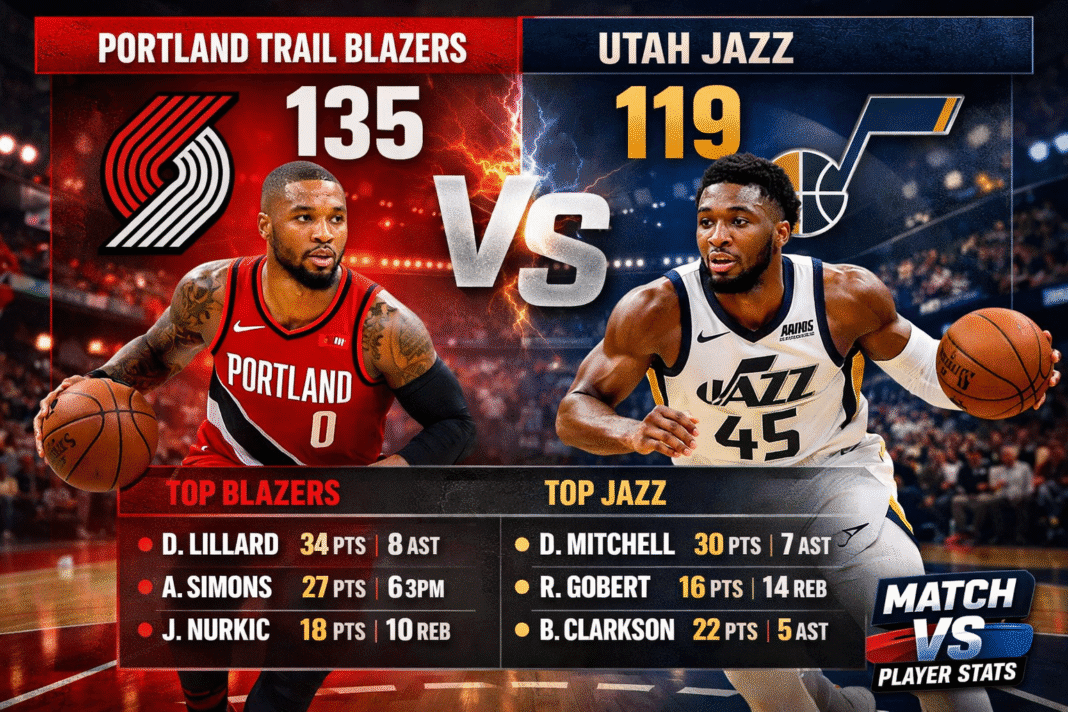
The Portland Trail Blazers vs Utah Jazz match player stats tell the story of a dominant road performance, as Portland cruised to a 135-119 victory at the Delta Center on February 13, 2026. Jrue Holiday led all scorers with 31 points while Donovan Clingan dominated the paint with 23 points and 18 rebounds in a game that saw the Blazers head into the All-Star break on a high note.
Table of contents
- Final Score and Top Performers
- Complete Player Statistics
- Team Statistics Breakdown
- Quarter-by-Quarter Scoring
- Game Context and Storylines
- Key Statistical Categories
- Individual Performance Analysis
- Statistical Trends and Patterns
- Rotation and Minutes Distribution
- Playoff Implications
- Looking Ahead
- Final Thoughts
Final Score and Top Performers
Portland Trail Blazers 135, Utah Jazz 119
The victory marked Portland’s fourth win in five games, improving their record to 27-29 and solidifying their hold on the ninth spot in the Western Conference. Holiday’s season-high scoring output, combined with Clingan’s double-double performance, proved too much for a Jazz squad dealing with significant roster limitations.
Utah (18-38) entered the contest already dealing with adversity after losing Jaren Jackson Jr. to knee surgery hours before tipoff. The NBA also hit the Jazz with a $500,000 fine earlier in the day for sitting healthy stars in recent games, adding another layer of controversy to the matchup.
Complete Player Statistics
Portland Trail Blazers Player Stats
| Player | PTS | REB | AST | FG | 3PT | FT | STL | BLK | TO |
|---|---|---|---|---|---|---|---|---|---|
| Jrue Holiday | 31 | 9 | 7 | 10-15 | 4-8 | 7-9 | 0 | 0 | 1 |
| Donovan Clingan | 23 | 18 | 7 | 8-12 | 0-1 | 7-9 | 0 | 3 | 0 |
| Jerami Grant | 18 | 3 | 0 | 7-17 | 2-8 | 2-2 | 1 | 2 | 4 |
| Scoot Henderson | 15 | 1 | 4 | 4-6 | 2-4 | 5-6 | 1 | 0 | 6 |
| Caleb Love | 11 | 0 | 2 | 4-12 | 3-8 | 0-0 | 0 | 0 | 0 |
| Vit Krejci | 11 | 5 | 2 | 4-9 | 2-6 | 1-2 | 1 | 1 | 1 |
| Sidy Cissoko | 8 | 4 | 1 | 3-4 | 1-2 | 1-1 | 2 | 0 | 1 |
| Rayan Rupert | 2 | 4 | 0 | 1-4 | 0-1 | 0-0 | 1 | 0 | 2 |
| Yang Hansen | 2 | 0 | 0 | 0-1 | 0-0 | 2-2 | 0 | 0 | 0 |
Utah Jazz Player Stats
| Player | PTS | REB | AST | FG | 3PT | FT | STL | BLK | TO |
|---|---|---|---|---|---|---|---|---|---|
| Brice Sensabaugh | 28 | 4 | 0 | 8-19 | 5-11 | 7-9 | 0 | 0 | 1 |
| Isaiah Collier | 15 | 2 | 9 | 3-8 | 0-0 | 9-12 | 3 | 0 | 4 |
| Ace Bailey | 15 | 8 | 3 | 7-15 | 1-5 | 0-0 | 0 | 0 | 4 |
| Svi Mykhailiuk | 14 | 1 | 3 | 5-8 | 4-5 | 0-0 | 1 | 0 | 2 |
| Cody Williams | 9 | 2 | 3 | 4-9 | 0-3 | 1-1 | 2 | 1 | 4 |
| Vince Williams Jr. | 6 | 3 | 0 | 3-5 | 0-1 | 0-0 | 0 | 0 | 1 |
| John Konchar | 6 | 7 | 3 | 2-7 | 0-3 | 2-3 | 3 | 2 | 0 |
Team Statistics Breakdown
Shooting Performance
Portland Trail Blazers
- Field Goal Percentage: 51.1% (46-90)
- Three-Point Percentage: 39.1% (18-46)
- Free Throw Percentage: 75.8% (25-33)
- Effective Field Goal Percentage: 61.1%
- True Shooting Percentage: 64.6%
Utah Jazz
- Field Goal Percentage: 48.3% (42-87)
- Three-Point Percentage: 36.8% (14-38)
- Free Throw Percentage: 72.4% (21-29)
- Effective Field Goal Percentage: 56.3%
- True Shooting Percentage: 59.6%
The Blazers shot the ball more efficiently across the board, particularly from beyond the arc where they connected on 18 triples compared to Utah’s 14. Portland’s 64.6% true shooting percentage reflected their ability to score at all three levels.
Rebounding Battle
| Category | Portland | Utah |
|---|---|---|
| Offensive Rebounds | 19 | 12 |
| Defensive Rebounds | 33 | 26 |
| Total Rebounds | 59 | 46 |
| Second Chance Points | 23 | 12 |
Portland dominated the glass with a 59-46 advantage, creating extra possessions that translated directly into points. The Blazers’ 19 offensive rebounds nearly doubled Utah’s output and led to 23 second-chance points, a decisive factor in the outcome.
Advanced Statistics
Portland Trail Blazers
- Offensive Rating: 126.7
- Defensive Rating: 111.5
- Pace: 106.52 possessions
- Points in the Paint: 52
- Bench Points: 41
Utah Jazz
- Offensive Rating: 111.5
- Defensive Rating: 126.7
- Pace: 106.76 possessions
- Points in the Paint: 48
- Bench Points: 37
Portland’s offensive rating of 126.7 showcased their ability to generate efficient scoring opportunities, while their defensive rating of 111.5 demonstrated solid containment despite Utah’s attempts to mount a comeback.
Quarter-by-Quarter Scoring
| Quarter | Portland | Utah |
|---|---|---|
| 1st | 28 | 31 |
| 2nd | 33 | 32 |
| 3rd | 40 | 23 |
| 4th | 34 | 33 |
| Final | 135 | 119 |
The third quarter proved decisive as Portland outscored Utah 40-23, turning a slim halftime deficit into a commanding lead. The Blazers opened the period with a blistering 21-6 run that effectively put the game out of reach.
Game Context and Storylines
Jazz Hit with Controversy
Hours before tipoff, the NBA levied a $500,000 fine against Utah for what the league deemed improper roster management. The Jazz had sat Lauri Markkanen and Jaren Jackson Jr. in the fourth quarter of recent games against Orlando and Miami, drawing scrutiny about competitive integrity.
The timing couldn’t have been worse for Utah. Jackson, acquired just days earlier from Memphis, was ruled out after a post-trade physical revealed a benign growth in his left knee requiring surgery. Markkanen sat out to rest on the second night of a back-to-back, while Keyonte George was sidelined with a sprained right ankle.
Williams Ejection Shifts Momentum
The Jazz suffered another blow when Vince Williams Jr., who arrived with Jackson in the Memphis trade, picked up two technical fouls and was ejected with 8:59 remaining in the second quarter. His ejection came after getting tangled with Portland’s Rayan Rupert while bringing the ball up the court, further depleting Utah’s already thin rotation.
Holiday’s Masterclass
Jrue Holiday scored a season-high 31 points in what proved to be a vintage performance from the veteran guard. Holiday shot an efficient 66.7% from the field (10-15) and added 50% shooting from three-point range (4-8). His nine rebounds and seven assists demonstrated his all-around impact.
The Trail Blazers, led by Jrue Holiday, turned the tides of the game in the third quarter and outscored Utah 40-23 to take a commanding lead, with its peak at 17 points. Holiday’s nine-point third quarter spearheaded the decisive run that broke the game open.
Clingan’s Breakout Performance
Donovan Clingan added 23 points and 18 rebounds while also recording a career-high seven assists. The rookie center dominated the paint against a Jazz frontcourt missing Walker Kessler and dealing with the absence of their newly acquired center.
His 18 rebounds represented a game-high total, with six coming on the offensive glass. Clingan also protected the rim with three blocked shots, showcasing the defensive versatility that made him a lottery pick.
Sensabaugh’s Scoring Effort
Brice Sensabaugh had 28 points to lead the Jazz scoring attack. The young guard shot 8-19 from the field and connected on five three-pointers, but his efforts weren’t enough to overcome Portland’s balanced attack.
Sensabaugh shouldered a heavy offensive burden with Utah’s depleted roster, but acknowledged the team’s slow start out of halftime. “I think we just came out a little too flat,” Sensabaugh said. “It’s been a theme for us in the past.”
Mykhailiuk’s Fourth Quarter Spark
Svi Mykhailiuk scored 14 points in the final quarter after not seeing action in the previous three games. The Ukrainian guard caught fire late, going 4-5 from three-point range and cutting Portland’s lead to single digits.
Jazz head coach Will Hardy praised Mykhailiuk’s professionalism despite the inconsistent playing time. “There’s times he’s been a starter, there’s times he’s out of the rotation and he always handles himself with a ton of class; he’s always prepared,” Jazz head coach Will Hardy said of Mykhailiuk.
Isaiah Collier echoed that sentiment: “He was great for us tonight,” Collier said. “Hit big shots, got us back in the game, gave us a spark, gave us energy.”
Despite Mykhailiuk’s heroics, the Jazz couldn’t generate enough defensive stops to complete the comeback.
Key Statistical Categories
Assists and Ball Movement
Portland distributed the ball effectively with 26 total assists, led by Holiday’s seven and Clingan’s seven. The Blazers’ ball movement created open looks that led to their efficient shooting night.
Utah countered with 28 assists, paced by Isaiah Collier’s nine helpers. The rookie point guard showed impressive court vision despite the loss, posting a 9-assist, 4-turnover line.
Turnover Battle
The turnover battle was nearly even, with Portland committing 21 turnovers to Utah’s 19. However, the Blazers converted Utah’s mistakes into 27 points off turnovers compared to the Jazz’s 23 points.
Portland forced six offensive fouls from Utah, helping neutralize their turnover disadvantage. Scoot Henderson’s six turnovers were a concern, but his efficient scoring (4-6 FG) helped offset the miscues.
Paint Presence
Portland scored 52 points in the paint compared to Utah’s 48, continuing their trend of inside dominance. The Blazers shot 65% on paint attempts (26-40) while the Jazz converted 60% (24-40).
Clingan’s presence in the restricted area created easy scoring opportunities for himself and teammates, while Holiday and Grant attacked the rim effectively throughout the contest.
Bench Production
Portland’s bench contributed 41 points, slightly edging Utah’s 37 bench points. Vit Krejci (11 points), Sidy Cissoko (8 points), and Yang Hansen (2 points) provided valuable minutes for the Blazers.
For Utah, Mykhailiuk’s 14 points led the reserves, with John Konchar adding 6 points, 7 rebounds, and 3 steals in a solid all-around effort.
Individual Performance Analysis
Jrue Holiday: Veteran Excellence
Holiday’s 31-point explosion came at the perfect time for Portland. His 66.7% field goal percentage and 80% effective field goal percentage demonstrated his shot selection and execution. The veteran guard also drew four fouls, getting to the free-throw line nine times and converting seven.
His plus-minus of +29 was the highest on either team, reflecting his impact on both ends of the floor. Holiday’s offensive rating of 179.4 showcased his efficiency as Portland’s primary scoring threat.
Donovan Clingan: Rising Star
The rookie center’s stat line of 23 points, 18 rebounds, and 7 assists represents one of the most complete performances by a first-year player this season. His offensive rebounding (6) created second-chance opportunities, while his defensive presence altered shots near the rim.
Clingan’s 72.1% true shooting percentage highlighted his finishing ability around the basket. His +21 plus-minus ranked second on the team, demonstrating his value in the winning effort.
Brice Sensabaugh: Bright Spot in Defeat
Despite the loss, Sensabaugh showed his scoring prowess with 28 points on 19 shot attempts. His 45.5% shooting from three-point range (5-11) kept Utah competitive during stretches when Portland threatened to pull away.
The young wing’s shot creation ability was on full display as he shouldered the offensive load for a shorthanded Jazz roster. His minus-27 plus-minus reflected the team’s overall struggles more than his individual performance.
Isaiah Collier: Playmaking Promise
Collier’s nine assists showcased his ability to run the offense and create for teammates. The rookie guard also added three steals, demonstrating his defensive activity and anticipation.
His free-throw shooting (9-12, 75%) proved crucial in keeping Utah within striking distance during the first half. Collier’s assist-to-turnover ratio of 2.25 was solid considering the pace of the game and his offensive responsibilities.
Ace Bailey: Athletic Flashes
Bailey contributed 15 points and 8 rebounds while displaying the athleticism that makes him an intriguing prospect. His 60% shooting on two-point attempts (6-10) showed his ability to finish around the basket.
The rookie forward grabbed three offensive rebounds, contributing to Utah’s second-chance opportunities. His plus-minus of minus-19 reflected the team’s defensive struggles when he was on the floor.
Statistical Trends and Patterns
Three-Point Shooting Volume
Portland attempted 46 three-pointers compared to Utah’s 38, reflecting the modern NBA’s emphasis on perimeter shooting. The Blazers’ 39.1% conversion rate from deep gave them a significant advantage, resulting in 12 additional points from beyond the arc.
Holiday (4-8), Scoot Henderson (2-4), and Caleb Love (3-8) combined for 9 three-pointers, spreading the floor and creating driving lanes.
Free Throw Disparity
Portland attempted four more free throws than Utah (33-29), with the difference coming from their aggressive drives to the basket. Holiday (7-9), Clingan (7-9), and Henderson (5-6) combined for 19 free-throw attempts, getting into the bonus early in most quarters.
Pace and Possessions
Both teams played at a fast pace, with Portland averaging 106.52 possessions and Utah at 106.76. This up-tempo style suited both squads but ultimately favored Portland’s superior shooting efficiency.
The Blazers scored 1.27 points per possession compared to Utah’s 1.11, a gap that proved insurmountable over the course of 40 minutes.
Rotation and Minutes Distribution
Portland’s rotation featured balanced minutes distribution, with no player exceeding 35 minutes. Holiday and Clingan led the way in playing time, while the bench provided meaningful contributions throughout.
Utah leaned heavily on their starters due to the depleted roster, with Sensabaugh, Collier, and Bailey all playing extended minutes. The lack of depth became apparent in the third quarter when fatigue seemed to impact defensive rotations.
Playoff Implications
The victory improved Portland’s record to 27-29, keeping them in the ninth position in the Western Conference playoff race. With four wins in their last five games, the Blazers are building momentum heading into the All-Star break.
Utah’s loss dropped them to 18-38, firmly entrenched in the lottery conversation. The combination of injuries, trades, and the NBA fine has created turbulence around the franchise as they navigate the season’s final stretch.
Looking Ahead
Portland enters the All-Star break with positive momentum and a relatively healthy roster, aside from long-term injuries to players like Damian Lillard. The week off provides an opportunity to rest and prepare for a push toward securing a play-in tournament berth.
Utah faces uncertainty on multiple fronts. Jackson’s knee surgery timeline, Markkanen’s health management, and the scrutiny from the league office create challenges as the Jazz evaluate their direction for the remainder of the season.
For comprehensive coverage of all NBA matchups and detailed player statistics throughout the season, visit Match vs Player Stats.
Final Thoughts
The portland trail blazers vs utah jazz match player stats from February 13, 2026, paint a picture of a team peaking at the right time facing a franchise dealing with significant adversity. Holiday’s 31-point masterpiece, supported by Clingan’s double-double dominance, proved too much for a depleted Jazz roster.
Portland’s balanced scoring attack, superior rebounding, and crucial third-quarter surge demonstrated their ability to capitalize on opponents’ weaknesses. Utah showed fight, particularly Mykhailiuk’s fourth-quarter rally, but couldn’t overcome the combination of injuries, ejections, and defensive lapses that defined their evening.
As both teams head into the All-Star break, Portland does so with confidence and momentum, while Utah contemplates roster decisions and recovery timelines that will shape their season’s final chapters.