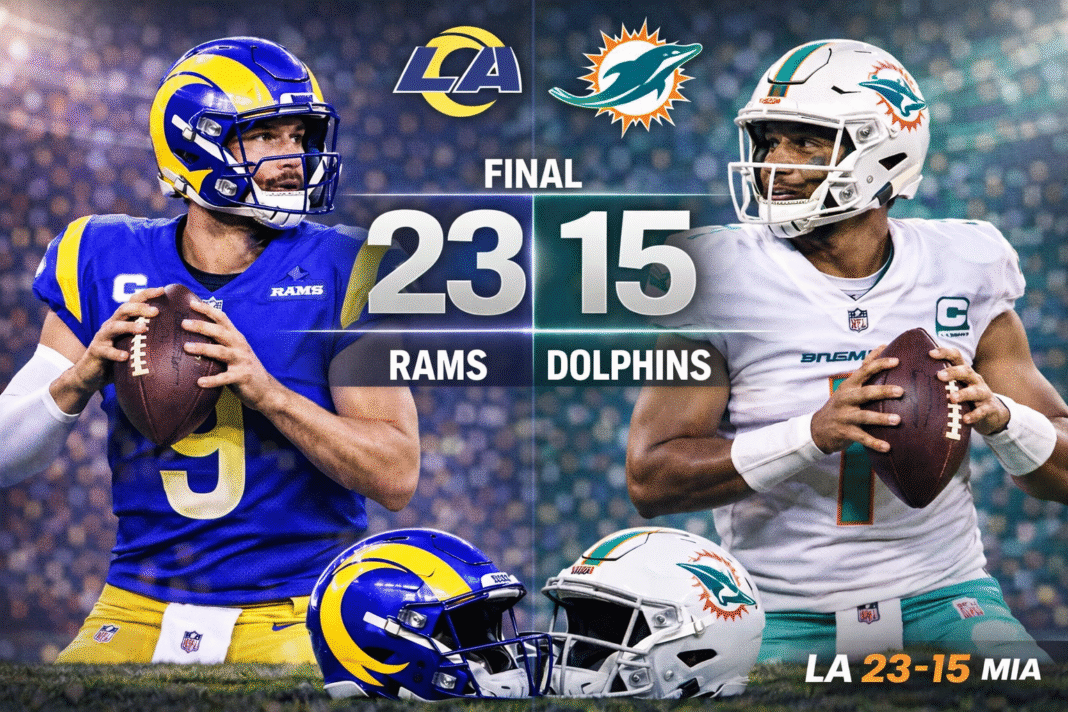
When the los angeles rams vs miami dolphins match player stats rolled in from their November 11, 2024 showdown at SoFi Stadium, the numbers told a story that surprised even the most analytical football minds. Miami walked away with a 23-15 victory, but the box score suggested a different narrative entirely. The Dolphins survived on grit while the Rams racked up yardage but couldn’t finish drives. Tua Tagovailoa threw for 207 yards and a touchdown with 20 completions on 28 attempts, while Matthew Stafford posted 293 yards despite connecting on 32 of 46 passes without finding the end zone.
Table of contents
- Final Score and Offensive Leaders
- Complete Passing Statistics
- Rushing Attack Breakdown
- Receiving Corps Performance
- Defensive Dominance: Sacks and Pressures
- Tackle Leaders and Defensive Stats
- Special Teams and Field Position Battle
- Team Statistics Comparison
- The Turning Points
- Impact Players and Standout Performances
- Red Zone Woes Cost the Rams
- Third Down Efficiency: The Real Difference
- Looking Back at This Rivalry
- What the Stats Really Mean
- The Bottom Line on Match Player Stats
Final Score and Offensive Leaders
Miami Dolphins 23, Los Angeles Rams 15
| Category | Miami Dolphins | Los Angeles Rams |
|---|---|---|
| Final Score | 23 | 15 |
| Passing Leader | Tua Tagovailoa (207 yards, 1 TD) | Matthew Stafford (293 yards, 0 TD) |
| Rushing Leader | De’Von Achane (37 yards) | Kyren Williams (62 yards) |
| Receiving Leader | Jaylen Waddle (57 yards) | Puka Nacua (98 yards) |
Complete Passing Statistics
The quarterback battle featured contrasting performances that defined the Monday Night Football matchup.
| Stat Category | Tua Tagovailoa (MIA) | Matthew Stafford (LAR) |
|---|---|---|
| Completions/Attempts | 20/28 | 32/46 |
| Completion % | 71.4% | 69.6% |
| Passing Yards | 207 | 293 |
| Yards Per Attempt | 7.4 | 6.4 |
| Touchdowns | 1 | 0 |
| Interceptions | 1 | 1 |
| Sacks/Yards Lost | 3/36 | 4/36 |
| QB Rating | 85.4 | 73.2 |
| Third Down Conversions | 9/12 (137 yards) | 3/12 |
Tagovailoa’s efficiency on third down became the difference maker in this contest. He converted nine of 12 third down attempts for 137 yards, keeping Miami drives alive when it mattered most. Stafford, meanwhile, struggled against pressure despite his higher yardage total, converting just three of 12 third down opportunities.
Rushing Attack Breakdown
The ground game never dominated for either squad, but both teams found moments to establish physicality.
| Player | Team | Attempts | Yards | Average | Long | TD |
|---|---|---|---|---|---|---|
| Kyren Williams | LAR | 15 | 62 | 4.1 | 14 | 0 |
| De’Von Achane | MIA | 12 | 37 | 3.1 | 11 | 0 |
| Malik Washington | MIA | 1 | 18 | 18.0 | 18 | 1 |
| Raheem Mostert | MIA | 4 | 12 | 3.0 | 8 | 0 |
Team Rushing Totals
| Team | Attempts | Yards | Average | TDs |
|---|---|---|---|---|
| Miami | 22 | 67 | 3.0 | 1 |
| Los Angeles | 18 | 70 | 3.9 | 0 |
Rookie receiver Malik Washington’s 18-yard rushing touchdown on the opening possession set the tone for Miami’s victory. The Rams averaged more per carry but couldn’t punch it in when opportunities arose.
Receiving Corps Performance
Wide receiver play created explosive moments throughout the game, though neither team could sustain consistent downfield attacks.
Miami Dolphins Receivers
| Player | Receptions | Targets | Yards | Average | Long | TD |
|---|---|---|---|---|---|---|
| Jaylen Waddle | 3 | 6 | 57 | 19.0 | 36 | 0 |
| Tyreek Hill | 3 | 5 | 16 | 5.3 | 10 | 1 |
| Odell Beckham Jr. | 3 | 4 | 35 | 11.7 | 17 | 0 |
| Jonnu Smith | 4 | 4 | 31 | 7.8 | 14 | 0 |
| De’Von Achane | 5 | 6 | 30 | 6.0 | 10 | 0 |
| Raheem Mostert | 1 | 1 | 25 | 25.0 | 25 | 0 |
| Malik Washington | 1 | 2 | 17 | 17.0 | 17 | 0 |
Los Angeles Rams Receivers
| Player | Receptions | Targets | Yards | Average | Long | TD |
|---|---|---|---|---|---|---|
| Puka Nacua | 9 | 12 | 98 | 10.9 | 21 | 0 |
| Cooper Kupp | 7 | 11 | 80 | 11.4 | 17 | 0 |
| Kyren Williams | 7 | 10 | 55 | 7.9 | 11 | 0 |
| Tyler Johnson | 4 | 5 | 35 | 8.8 | 10 | 0 |
| Demarcus Robinson | 2 | 3 | 11 | 5.5 | 7 | 0 |
| Davis Allen | 3 | 5 | 14 | 4.7 | 6 | 0 |
Nacua led all receivers with 98 yards on nine catches in what was just his second game back from injury. Kupp added seven receptions for 80 yards, marking the first time since Week 1 that both elite receivers played together. Yet despite this firepower, the Rams offense couldn’t crack the end zone.
According to NFL Network’s report, Jaylen Waddle’s 36-yard catch on a crucial third and 13 play in the second quarter extended Miami’s scoring drive and showcased his explosiveness.
Defensive Dominance: Sacks and Pressures
Defense won this Monday night battle, with both teams bringing consistent heat on opposing quarterbacks.
Sack Leaders
| Player | Team | Sacks | QB Hits | Pressures | Tackles |
|---|---|---|---|---|---|
| Calais Campbell | MIA | 1.0 | 2 | 2 | 2 |
| Chop Robinson | MIA | 1.0 | 5 | 5 | 3 |
| Kobie Turner | LAR | 1.0 | 1 | 3 | 2 |
| Jared Verse | LAR | 1.0 | 2 | 4 | 4 |
| Zach Sieler | MIA | 0.0 | 0 | 2 | 2 |
Miami’s defense recorded four sacks, setting a season high while holding Los Angeles scoreless in the touchdown column for the first time since November 5, 2023. Rookie edge rusher Chop Robinson tied his season high with five pressures, showcasing why he became a finalist for Defensive Rookie of the Year.
Next Gen Stats revealed that Robinson generated his five pressures on just 30 pass rush snaps, creating a 16.7% pressure rate. Four of those pressures came against right tackle Joe Noteboom, who was playing in his first game since Week 1.
The veteran Campbell forced Stafford’s interception and added two pressures despite being double-teamed frequently. Zach Sieler, returning from injury, faced double teams on 58.1% of his 43 pass rushing snaps yet still managed two quarterback pressures.
Tackle Leaders and Defensive Stats
Top Tacklers
| Player | Team | Position | Total | Solo | Assisted | TFL | PD |
|---|---|---|---|---|---|---|---|
| Jordyn Brooks | MIA | LB | 11 | 6 | 5 | 1 | 0 |
| Omar Speights | LAR | LB | 8 | 6 | 2 | 0 | 0 |
| Anthony Walker Jr. | MIA | LB | 7 | 5 | 2 | 0 | 1 |
| Kader Kohou | MIA | CB | 6 | 4 | 2 | 0 | 1 |
| Quentin Lake | LAR | S | 6 | 5 | 1 | 0 | 0 |
Brooks led all defenders with 11 tackles, providing steady linebacker play throughout the contest. The Dolphins limited explosive plays while forcing the Rams into tough third down situations all night.
Interceptions and Turnovers
| Player | Team | Interceptions | Fumbles Forced | Fumbles Recovered |
|---|---|---|---|---|
| Christian Rozeboom | LAR | 1 | 0 | 0 |
| Anthony Walker Jr. | MIA | 1 | 0 | 0 |
| Jared Verse | LAR | 0 | 1 | 1 |
Both teams turned the ball over twice. Verse’s forced fumble and recovery in the second quarter showed exactly why he would go on to win the 2024 AP Defensive Rookie of the Year award, beating out finalists including Robinson, teammate Braden Fiske, and Eagles cornerbacks Quinyon Mitchell and Cooper DeJean.
Special Teams and Field Position Battle
Kicking Stats
| Kicker | Team | Field Goals | Extra Points | Long | Total Points |
|---|---|---|---|---|---|
| Jason Sanders | MIA | 3/3 (100%) | 2/2 | 50 | 11 |
| Joshua Karty | LAR | 5/6 (83.3%) | 0/0 | 37 | 15 |
Sanders nailed all three field goal attempts, including a crucial 50-yarder with 2:38 remaining that extended Miami’s lead to 11 points. Karty missed one attempt but kept the Rams competitive with five successful kicks.
Punting Battle
| Punter | Team | Punts | Average | Inside 20 | Long |
|---|---|---|---|---|---|
| Jake Bailey | MIA | 4 | 47.8 | 2 | 56 |
| Ethan Evans | LAR | 3 | 44.7 | 1 | 52 |
Team Statistics Comparison
The overall numbers painted a picture of Rams dominance that never materialized on the scoreboard.
| Category | Miami Dolphins | Los Angeles Rams |
|---|---|---|
| Total Yards | 238 | 327 |
| First Downs | 15 | 20 |
| Third Down Conversions | 6/13 (46.2%) | 3/12 (25.0%) |
| Fourth Down Conversions | 0/0 | 0/0 |
| Red Zone Efficiency | 2/3 (66.7%) | 0/3 (0%) |
| Penalties | 1-15 | 6-64 |
| Turnovers | 2 | 2 |
| Time of Possession | 29:48 | 30:12 |
| Sacks Allowed | 4-36 | 3-36 |
The red zone efficiency tells the entire story. Miami capitalized on two of three trips inside the 20-yard line while Los Angeles went 0 for 3, settling for field goals each time. That difference decided the ballgame.
Los Angeles held a slight edge in time of possession and outgained Miami by 89 yards, yet the Dolphins executed when it mattered. Six penalties for 64 yards hurt the Rams at critical moments, disrupting rhythm and killing drives.
The Turning Points
Several pivotal sequences shaped this Monday night contest.
First Quarter: Miami’s Opening Statement
Rookie Malik Washington rushed 18 yards for his first NFL touchdown on the opening possession, giving Miami a 7-0 lead. The Dolphins marched 70 yards in 11 plays, setting an aggressive tone immediately.
Second Quarter: Defensive Battle
Both quarterbacks threw interceptions on consecutive drives. Tagovailoa’s pick to Christian Rozeboom resulted in a scary moment when the quarterback lowered his helmet to make a tackle, concerning everyone given his concussion history earlier in the season. Stafford then threw his interception to Anthony Walker Jr., who returned it 30 yards.
According to reports from CBS Sports, Stafford had ball-handling issues throughout the quarter, bobbling snaps and fumbling on play-action fakes that disrupted promising drives.
Third Quarter: Hill Breaks Through
Tyreek Hill caught a short touchdown pass from Tagovailoa, ending the longest scoring drought of his career. The score extended Miami’s lead to 17-6 and provided crucial breathing room.
Fourth Quarter: Missed Opportunities
The Rams drove to Miami’s 4-yard line but settled for their fourth field goal with 6:31 remaining, making it a one-score game at 20-12. Former Ram Odell Beckham Jr. then converted a critical third and six at the stadium where he won Super Bowl LVI, extending Miami’s drive. Sanders followed with his 50-yard field goal to essentially seal the victory.
ESPN’s analysis noted that Tagovailoa overcame a potentially disastrous second quarter to convert five third down attempts, showing mental toughness in bouncing back from his turnover.
Impact Players and Standout Performances
Tua Tagovailoa’s Clutch Play
Despite modest yardage, Tagovailoa delivered when the Dolphins needed him most. His 9 of 12 performance on third downs for 137 yards kept drives alive and the clock moving in Miami’s favor. He connected with six different receivers, spreading the ball effectively.
Miami coach Mike McDaniel praised his quarterback’s resilience after the game, noting how Tagovailoa has matured in handling adversity during his fifth NFL season.
Matthew Stafford’s Frustrating Night
Stafford’s 293 passing yards looked impressive until you dig deeper. Zero touchdowns against a Dolphins defense ranked 26th in pass defense entering the game told the real story. The 13 quarterback pressures and four sacks disrupted his timing all night.
This marked just the second time in 50 games that Stafford started at quarterback for the Rams without throwing a touchdown pass. The first occurred on November 5, 2023 at Green Bay when Stafford was injured.
Cooper Kupp and Puka Nacua’s Return
Both receivers returned from injury for the first time since Week 1, combining for 16 receptions and 178 yards. Their presence opened up the offense, creating better spacing and forcing defensive adjustments. Yet without touchdown production, the reunion felt incomplete.
Los Angeles gained 386 total yards in Week 8 against Minnesota with both receivers healthy, showing their true impact. Against Miami, they moved the ball but couldn’t finish, highlighting the red zone struggles.
Defensive Rookie Impact: Robinson vs Verse
Chop Robinson and Jared Verse, two of the top rookie defensive players in the 2024 class, showcased why they became award finalists. Robinson’s five pressures tied his season high while Verse added a sack and forced fumble, demonstrating the disruptive ability that would earn him AP Defensive Rookie of the Year honors.
Both players would go on to become cornerstones of their respective defenses. Robinson finished his rookie campaign with six sacks and 14 quarterback hits, both second among first-year players. Verse led all rookies in quarterback hits (18), pressures (77), and hurries (56).
Red Zone Woes Cost the Rams
The most glaring statistic from this matchup was Los Angeles going 0 for 3 in the red zone. Three trips inside Miami’s 20-yard line produced zero touchdowns and just nine points from field goals.
After scoring 76 points in their previous three wins, the Rams couldn’t find the end zone for the first time since Stafford’s injury absence over a year earlier. Play calling became conservative, execution faltered, and Miami’s defense stiffened at critical moments.
The Dolphins defense forced three sacks on third down, killing Rams drives at the worst possible moments. Miami’s red zone defense stood tall when backed against the wall, showcasing championship-caliber grit.
Third Down Efficiency: The Real Difference
Beyond the red zone, third down conversions separated these teams dramatically.
Miami converted 6 of 13 attempts (46.2%), with Tagovailoa completing 9 of 12 passes for 137 yards on money downs. The Dolphins moved chains consistently, controlling tempo and keeping their defense fresh.
Los Angeles managed just 3 of 12 third down conversions (25.0%), well below their season average of 36% entering the game. Stafford faced pressure repeatedly on third downs, forcing quick throws and poor decisions.
This disparity in critical situations allowed Miami to dominate time of possession in key stretches despite the Rams holding a slight overall edge.
Looking Back at This Rivalry
The Dolphins improved to 4-6 with the victory while the Rams dropped to 4-5, falling below .500 for the first time since their Week 6 bye. Both teams entered must-win territory for their playoff hopes.
Miami snapped a three-game losing streak, having dropped close contests by a combined 10 points since their last victory on October 6. The road win in Los Angeles provided hope that their season could be salvaged.
For the Rams, the home loss stung. They entered 3-2 at SoFi Stadium but fell to 3-3, seeing their three-game winning streak end in disappointing fashion. The lack of touchdowns raised concerns about red zone execution moving forward.
Historically, Miami holds advantages over Los Angeles in multiple statistical categories. The Dolphins finish drives more efficiently while the Rams move the ball better between the 20s. This November night perfectly exemplified that dynamic.
What the Stats Really Mean
Raw yardage meant nothing in this contest. The Rams outgained Miami 327 to 238 but lost by eight points, proving the old adage that points matter more than yards.
Efficiency in critical situations determined the outcome. Third downs, red zone opportunities, and penalty avoidance became the difference makers. Miami excelled in all three areas while Los Angeles struggled across the board.
The defensive performances deserve recognition beyond basic box score stats. Miami’s four sacks came at opportune moments, forcing punts and field goals instead of touchdowns. The Dolphins pass rush reached season-high production when they needed it most.
Stafford faced constant pressure despite the Rams having guards Steve Avila and Jonah Jackson return from injured reserve. The offensive line allowed four sacks after giving up just one combined in their previous three games.
For more comprehensive player statistics and game analysis, visit MatchVsPlayerStats.com for detailed breakdowns of NFL matchups.
The Bottom Line on Match Player Stats
The los angeles rams vs miami dolphins match player stats from November 11, 2024 revealed a classic case of stats versus results. Los Angeles dominated yardage but Miami dominated when it mattered. Tagovailoa’s 207 yards with clutch third down conversions beat Stafford’s 293 yards with zero touchdowns. The Dolphins’ 2 for 3 red zone efficiency crushed the Rams’ 0 for 3 futility. Jordyn Brooks’ 11 tackles and Miami’s four-sack performance on defense sealed a gritty 23-15 road victory that kept playoff hopes alive.
This Monday night matchup proved that execution trumps accumulation in the NFL. The team that converts opportunities wins, regardless of total yardage. Miami understood that lesson while Los Angeles learned it the hard way in front of their home crowd.