The Indianapolis Colts vs New York Jets match player stats from Week 11 captured Anthony Richardson’s comeback from a two-game benching: 272 passing yards and two rushing touchdowns powered a 28-27 thriller at MetLife Stadium on November 17, 2024. Josh Downs caught all five targets for 84 yards and a touchdown, while Breece Hall led the Jets with 121 total yards and two scores despite Aaron Rodgers completing 22 of 29 passes for 184 yards.
Quick Hits
Final Score: Colts 28, Jets 27
Game Winner: Richardson 4-yard TD run with 46 seconds left
Key Stat: Colts dominated possession 34:17 to 25:43
Critical Moment: Pierce 39-yard catch after Richardson pump fake with 2:15 left
Top Performers
COLTS:
- Anthony Richardson (QB): 66.7% completion rate (20/30), 272 yards, 1 pass TD, 2 rush TDs
- Josh Downs (WR): Perfect 5/5 on targets, 84 yards, 1 TD
- Kwity Paye (DE): 2 sacks, 7 tackles, game-sealing strip of Rodgers
JETS:
- Breece Hall (RB): 121 total yards, 2 TDs (16 car/78 yds + 7 rec/43 yds)
- Aaron Rodgers (QB): 75.9% completion rate (22/29), 184 yards, 2 TDs, 114.7 rating
- Davante Adams (WR): 6 receptions, 72 yards on 7 targets
Table of Contents
Game Summary
| Category | Indianapolis | New York |
|---|---|---|
| Final Score | 28 | 27 |
| Total Yards | 332 | 253 |
| First Downs | 18 | 10 |
| Time of Possession | 34:17 | 25:43 |
| Third Down Efficiency | 6-15 (40%) | 4-13 (31%) |
| Fourth Down Efficiency | 1-2 | 0-1 |
| Turnovers | 1 | 0 |
| Penalties | 5-40 | 2-14 |
Indianapolis controlled possession for over 34 minutes and generated 79 more total yards than New York. The Colts converted third downs at a better clip despite attempting two more than the Jets. New York kept penalties to a minimum with just two infractions for 14 yards, while Indianapolis committed five for 40 yards.
Passing Statistics
Indianapolis Colts Passing
| Player | Completions | Attempts | Yards | TDS | INTS | Sacks | Rating |
|---|---|---|---|---|---|---|---|
| Anthony Richardson | 20 | 30 | 272 | 1 | 0 | 2-31 | 106.5 |
The quarterback statistics from this matchup show Richardson shattered his previous career best of 223 passing yards, set in his NFL debut last season. The 22-year-old averaged 9.1 yards per attempt, attacked downfield when opportunities presented themselves. Nine different receivers caught passes, which demonstrated Richardson’s willingness to distribute the ball rather than force throws to primary targets.
His efficiency on critical third downs extended drives when the offense needed conversions. The pump fake that set up Alec Pierce’s 39-yard catch showed Richardson’s ability to manipulate safeties with his eyes, freezing the deep help just long enough for Pierce to streak past the coverage.
New York Jets Passing
| Player | Completions | Attempts | Yards | TDS | INTS | Sacks | Rating |
|---|---|---|---|---|---|---|---|
| Aaron Rodgers | 22 | 29 | 184 | 2 | 0 | 3-22 | 114.7 |
The 40-year-old veteran completed 75.9% of his attempts but averaged just 6.3 yards per throw. Rodgers targeted eight different pass catchers, kept the offense unpredictable despite limited yardage output. His two touchdown passes gave New York scoring bursts when the running game stalled, but the conservative attack rarely threatened Indianapolis deep.
Quick passes negated the Colts’ pass rush early, but that approach limited explosive plays. Rodgers’ efficiency numbers appeared solid, yet the offense managed just 253 total yards and struggled to sustain drives.
Rushing Statistics
Indianapolis Colts Rushing
| Player | Carries | Yards | Average | TDS | Long |
|---|---|---|---|---|---|
| Jonathan Taylor | 24 | 57 | 2.4 | 0 | 10 |
| Anthony Richardson | 10 | 32 | 3.2 | 2 | 5 |
| Adonai Mitchell | 1 | 2 | 2.0 | 0 | 2 |
| Team Total | 35 | 91 | 2.6 | 2 | 10 |
Taylor handled 24 carries but found little running room against New York’s defensive front. His 2.4 yards per rush reflected consistent traffic in the backfield, yet the Colts kept feeding him to control the clock. Richardson’s 10 attempts generated two critical touchdowns, including the game winner with 46 seconds remaining. His ability to threaten the edge forced the Jets to respect quarterback runs, opening running lanes for Taylor on subsequent plays.
New York Jets Rushing
| Player | Carries | Yards | Average | TDS | Long |
|---|---|---|---|---|---|
| Breece Hall | 16 | 78 | 4.9 | 1 | 18 |
| Braelon Allen | 2 | 6 | 3.0 | 0 | 4 |
| Aaron Rodgers | 1 | 7 | 7.0 | 0 | 7 |
| Team Total | 20 | 91 | 4.6 | 1 | 18 |
Hall’s 4.9 yards per carry nearly doubled Taylor’s average, the most efficient rushing performance on the field. His 18-yard touchdown run early in the third quarter gave the Jets their first lead after Javon Kinlaw’s strip-sack set up excellent field position. New York ran just 20 times compared to Indianapolis’s 35, reflecting their pass-heavy approach and playing from behind for much of the contest.
Receiving Statistics
Indianapolis Colts Receiving
| Player | Receptions | Targets | Yards | TDS | Long |
|---|---|---|---|---|---|
| Josh Downs | 5 | 5 | 84 | 1 | 31 |
| Alec Pierce | 3 | 4 | 74 | 0 | 39 |
| Michael Pittman Jr. | 5 | 8 | 46 | 0 | 20 |
| Adonai Mitchell | 1 | 2 | 33 | 0 | 33 |
| Mo Alie-Cox | 2 | 3 | 17 | 0 | 12 |
Downs finished perfect on his five targets, averaged 16.8 yards per catch while he found soft spots in zone coverage. His 10-yard touchdown reception in the fourth quarter cut the Jets’ lead to two points and brought Indianapolis back into contention. Pierce’s 39-yard reception on the game-winning drive came after Richardson pump-faked the safety, allowing Pierce to blow past the cornerback on a go route down the right sideline.
Pittman’s eight targets led all Colts receivers, working as Richardson’s reliable underneath option when primary reads weren’t open. His 20-yard catch on third-and-11 in the third quarter extended a drive that resulted in Matt Gay’s 56-yard field goal.
New York Jets Receiving
| Player | Receptions | Targets | Yards | TDs | Long |
|---|---|---|---|---|---|
| Davante Adams | 6 | 7 | 72 | 0 | 24 |
| Breece Hall | 7 | 7 | 43 | 1 | 29 |
| Garrett Wilson | 4 | 8 | 18 | 0 | 7 |
| Xavier Gipson | 1 | 1 | 17 | 0 | 17 |
| Kenny Yeboah | 1 | 1 | 11 | 1 | 11 |
Adams topped Jets receivers with 72 yards, catching six of seven targets despite rarely threatening deep. Hall functioned as Rodgers’ checkdown option with seven receptions out of the backfield. His 29-yard touchdown catch before halftime came on a short pass that Hall turned into a long gain, accumulating 28 yards after the catch.
Wilson managed just 18 yards on eight targets, his quietest output of the 2024 season. The 2.25 yards per target suggested tight coverage limited his separation opportunities. Yeboah scored his first career touchdown on an 11-yard grab that put the Jets ahead 24-16, slipping behind linebacker E.J. Speed in the flat.
Defensive Statistics
Indianapolis Colts Defense
| Player | Tackles | Solo | Sacks | TFL | QB Hits | Pass Def |
|---|---|---|---|---|---|---|
| E.J. Speed | 9 | 4 | 0 | 0 | 0 | 0 |
| Kenny Moore II | 8 | 6 | 0 | 1 | 0 | 0 |
| Kwity Paye | 7 | 6 | 2.0 | 2 | 2 | 0 |
| DeForest Buckner | 6 | 2 | 0 | 1 | 0 | 0 |
| Jaylon Jones | 5 | 3 | 0 | 0 | 0 | 2 |
| Laiatu Latu | 3 | 2 | 1.0 | 2 | 3 | 0 |
The fourth quarter belonged to Kwity Paye, who registered both sacks in crucial situations. His strip of Rodgers on the final play came on a speed rush around left tackle Olumuyiwa Fashanu, beating him cleanly to end New York’s comeback attempt. Speed’s nine tackles came from pursuing plays across the field, though his involvement on so many stops reflected how often the Jets moved the ball.
Pro Football Focus graded Laiatu Latu at 89.4, the highest defensive mark in the game. His three quarterback hits disrupted timing on multiple dropbacks, forced Rodgers into quicker decisions than he preferred. Moore blanketed slot receivers throughout, allowed six catches on six targets but limited yards after the catch.
New York Jets Defense
| Player | Tackles | Solo | Sacks | TFL | QB Hits | Pass Def |
|---|---|---|---|---|---|---|
| Micheal Clemons | 8 | 3 | 0 | 0 | 1 | 0 |
| Quinnen Williams | 7 | 4 | 1.0 | 2 | 3 | 0 |
| Jalen Mills | 6 | 4 | 0 | 0 | 0 | 0 |
| Jamien Sherwood | 6 | 4 | 0 | 0 | 1 | 0 |
| Quincy Williams | 6 | 3 | 0 | 0 | 0 | 0 |
| Javon Kinlaw | 5 | 2 | 1.0 | 1 | 0 | 0 |
Quinnen Williams disrupted Indianapolis’s interior running game throughout, collapsed the pocket on passing downs and clogged running lanes. His three quarterback hits forced Richardson to step up into pressure multiple times. Kinlaw’s strip-sack in the third quarter came on a delayed blitz up the middle, where he split the guard and center untouched. Richardson never saw him coming and fumbled on contact at the Colts 25, with Kinlaw alertly falling on the loose ball himself.
Clemons finished with a team-high eight tackles, tracked plays from his edge position. The defensive front held Indianapolis to 2.6 yards per rush and sacked Richardson twice, yet couldn’t generate stops in crucial fourth-quarter moments.
Special Teams Performance
Kicking
| Team | Kicker | FG | Long | XP | Points |
|---|---|---|---|---|---|
| Colts | Matt Gay | 3/3 | 56 | 1/1 | 10 |
| Jets | Anders Carlson | 2/2 | 58 | 3/3 | 9 |
The special teams box score shows both kickers delivered in a one-point game. Gay connected on all three field goal attempts, including a crucial 56-yarder in the third quarter that restored Indianapolis’s lead. Carlson, elevated from the practice squad the day before, drilled a career-best 58-yard field goal that barely cleared the right upright to give New York a 17-16 advantage.
Punting
| Team | Punter | Punts | Yards | Average | Long | Inside 20 |
|---|---|---|---|---|---|---|
| Colts | Rigoberto Sanchez | 4 | 200 | 50.0 | 58 | 0 |
| Jets | Thomas Morstead | 5 | 277 | 55.4 | 63 | 1 |
Morstead averaged 55.4 yards per punt, repeatedly flipped field position when the Jets offense stalled. His 63-yard boot in the first quarter backed Indianapolis to their own 20. Sanchez averaged exactly 50 yards per punt but failed to pin any inside the 20-yard line.
Returns
Kick Returns:
- Tyler Goodson (IND): 3 returns, 71 yards, 23.7 average
- Ashton Dulin (IND): 1 return, 43 yards
- Isaiah Davis (NYJ): 1 return, 24 yards
Punt Returns:
- Josh Downs (IND): 3 returns, 37 yards, 12.3 average
- Xavier Gipson (NYJ): 3 returns, 19 yards, 6.3 average
Dulin’s 43-yard return set up Indianapolis with favorable field position, which led to their second field goal. Downs averaged 12.3 yards per punt return, nearly double Gipson’s 6.3-yard average.
How the Game Unfolded
First Half Dominance
Indianapolis controlled the opening 30 minutes at MetLife Stadium. The Colts scored on two of their first three possessions, built a 13-0 advantage while New York’s offense sputtered. The Jets failed to record a first down until their sixth possession late in the second quarter, managed just nine yards on their first nine plays.
The Jets finally broke through when Rodgers connected with Hall on a 29-yard catch and run with 40 seconds left before halftime. Hall did most of the work after the catch, accumulating 28 yards after contact on the play. That touchdown made it 13-7 and shifted momentum toward New York heading into the break.
Second Half Momentum Shift
The momentum flipped completely after halftime. Javon Kinlaw blitzed untouched up the middle on Indianapolis’s second snap of the third quarter, drilled Richardson before he could set his feet. The ball popped loose, and Kinlaw dove on it at the Colts 25. Two plays later, Hall took a handoff left, cut back against the grain, and raced 18 yards into the end zone. The Jets took their first lead, 14-13, just 47 seconds into the second half.
Gay’s 56-yard field goal put Indianapolis back ahead 16-14 midway through the third quarter after the offense stalled at the Jets 38. Carlson answered with his 58-yard career best to make it 17-16 Jets. A 15-yard fair catch interference penalty on Dulin gave New York the ball at the Colts 38, giving Carlson position for his long kick that barely cleared the uprights.
Yeboah’s first career touchdown, an 11-yard reception where he leaked out of the backfield unnoticed, extended the Jets’ lead to 24-16 early in the fourth quarter. Richardson responded immediately, marched Indianapolis 70 yards in eight plays. His 10-yard touchdown pass to Downs in the flat cut the deficit to 24-22, but Mo Alie-Cox couldn’t haul in the two-point conversion attempt.
Fourth Quarter Heroics
Rodgers engineered what appeared to be a game-closing drive. He converted a critical third-and-14 with a 17-yard completion to Gipson over the middle. Carlson’s 35-yard field goal with 2:41 remaining made it 27-22 Jets, seemingly putting the game out of reach.
Richardson took over with 2:41 left needing a touchdown. After a four-yard run on first down, Richardson faced second-and-six from his own 34. He dropped back, pump-faked toward the middle, and launched deep right to Pierce. The safety bit on the pump fake, freezing for a critical split-second. Pierce streaked past the cornerback, who had inside leverage but couldn’t recover. Richardson dropped the ball perfectly downfield, and Pierce secured it at the Jets 37, stumbling forward to the 27.
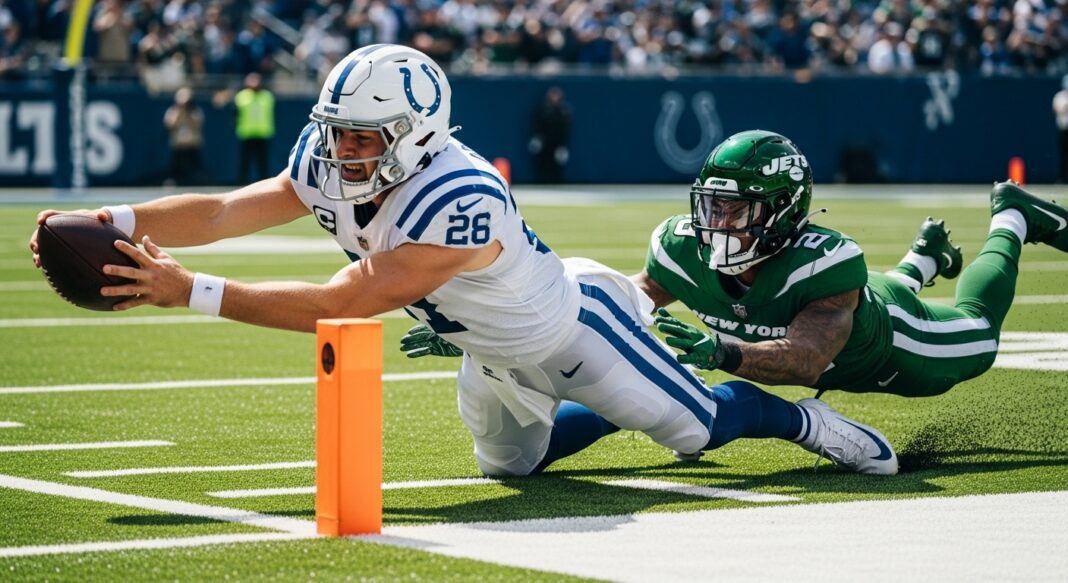
After the two-minute warning, Richardson found Downs breaking open over the middle for 17 yards, putting Indianapolis at first-and-goal from the 10. Taylor gained three yards on first down. Richardson threw incomplete on second down, stopping the clock. Facing third-and-goal from the four with 51 seconds left, Richardson took the shotgun snap and rolled right. He broke through the defensive front and dove across the goal line for the game-winning touchdown. The Colts led 28-27 with 46 seconds left. Jonathan Taylor couldn’t convert the two-point try, stopped for no gain.
Paye ended New York’s final possession by beating left tackle Fashanu with pure speed around the edge. Rodgers stepped up to avoid the pressure, but Paye redirected and brought him down at the Jets 28 on third-and-seven. The Colts snapped a three-game losing streak and improved to 5-6. The Jets fell to 3-8, their seventh loss in eight games.
Richardson’s Return Performance
The young quarterback’s 272 passing yards obliterated his previous career mark of 223. Richardson completed 66.7% of his throws and averaged 9.1 yards per attempt, both significant improvements over his earlier 2024 performances. His accuracy on third down extended possessions in key moments.
Coach Shane Steichen praised Richardson’s approach after the game: “The way he played, the way he battled today was phenomenal.”
Beyond the passing statistics, Richardson’s legs provided the crucial difference. His two rushing touchdowns showcased his physical running style and willingness to absorb contact. He lowered his shoulder into safety Jalen Mills on the second-quarter two-yard score, refused to slide or run out of bounds.
The benching clearly impacted Richardson’s mindset. He appeared more patient, took what the defense gave him rather than hunting big plays every snap. His nine different targets reflected a willingness to spread the ball around and trust his supporting cast.
Jets Offensive Struggles
New York’s offensive statistics averaged just 4.9 yards per play compared to Indianapolis’s 5.0. The Jets managed nine yards on their first nine offensive snaps, set a disastrous tone that lasted through halftime. First downs came sparingly until late in the second quarter, when Rodgers began connecting on passes.
His efficiency numbers looked solid on paper (75.9% completion rate, 114.7 passer rating), but the conservative attack limited explosive plays. The 6.3 yards per attempt revealed an offense focused on underneath routes and quick passes. That approach neutered Indianapolis’s pass rush initially but prevented the downfield shots needed to build big leads.
Hall remained New York’s most consistent offensive threat with 121 total yards on 23 touches. He caught all seven targets when coverage tightened downfield. Both touchdowns came at crucial moments, but the offense couldn’t sustain drives.
Wilson’s quiet performance (18 yards on eight targets) hurt significantly. His 2.25 yards per target marked his least productive game of 2024. Without Wilson’s production on intermediate routes, the Colts could focus defensive attention on Adams and Hall.
The offensive struggles that appeared the previous week against Arizona, where the Jets went 0-for-3 in the red zone and managed just 207 total yards, resurfaced in this game. New York entered this matchup having dropped four straight games, including a Week 8 loss to New England.
Defensive Execution
Indianapolis’s defense bent repeatedly but made key stops in crucial situations. The Colts allowed 253 total yards but forced New York to settle for field goals twice. Third-down stops prevented several Jets drives from continuing, particularly in the fourth quarter when the outcome remained undecided.
The coverage breakdown on Pierce’s 39-yard reception proved catastrophic for New York. The safety, responsible for deep help over the top, bit hard on Richardson’s pump fake and couldn’t recover. The cornerback, playing man coverage on the outside, had inside leverage but couldn’t match Pierce’s straight-line speed. The single play essentially decided the outcome, put Indianapolis in scoring range with under three minutes remaining.
New York’s defense generated pressure and forced a fumble but couldn’t finish drives with stops. Kinlaw’s strip-sack and recovery handed the Jets the ball at the Colts 25, which they converted into Hall’s go-ahead touchdown. However, the unit couldn’t get stops on key downs in the final quarter.
The Colts converted 40% of third downs (6 of 15), extending possessions that should have ended in punts. Richardson’s mobility on third down posed challenges the Jets couldn’t solve schematically. When initial coverage held, he escaped the pocket and either ran for first downs or extended plays until receivers found open space.
Paye’s dominance over the final 15 minutes decided the game. His two sacks both came on crucial downs. The speed-to-power rush combination overwhelmed Fashanu, who was making his first start at left tackle after Tyron Smith was ruled inactive with a neck injury. Fashanu struggled to handle Paye’s initial burst off the line, gave up inside position repeatedly.
Season Implications
The victory kept Indianapolis (5-6) within reach of playoff contention in a crowded AFC. Richardson’s performance validated the team’s decision to reinstate him as the starter over veteran Joe Flacco. His dual-threat ability forces defenses into difficult decisions schematically, opens opportunities that wouldn’t exist with a pocket passer.
The loss dropped New York to 3-8, effectively ended playoff aspirations before Thanksgiving. The Jets lost seven of their last eight games, a disastrous collapse after early season optimism. Offensive inconsistency, defensive lapses in critical moments, and special teams penalties at bad times defined New York’s 2024 campaign.
This Week 11 matchup at MetLife Stadium captured both teams at crossroads moments. Indianapolis identified its offensive approach with Richardson back under center, committed to his development despite the inconsistencies that come with a young quarterback. The Colts’ willingness to lean on their running game and trust Richardson in crucial moments resulted in a thrilling comeback victory.
New York’s fundamental problems became increasingly apparent as the season progressed. The defensive talent couldn’t overcome offensive limitations, and close games escaped them due to execution failures rather than talent deficits. Richardson established himself as Indianapolis’s franchise quarterback over the following months, while the Jets continued searching for offensive consistency.
The complete game statistics from this November 17, 2024 contest demonstrate how individual performances in critical moments decide NFL games. Richardson’s career-high passing yards, Paye’s clutch sacks, and Hall’s dual-threat production all influenced the outcome, but ultimately execution in key situations separated winner from loser.