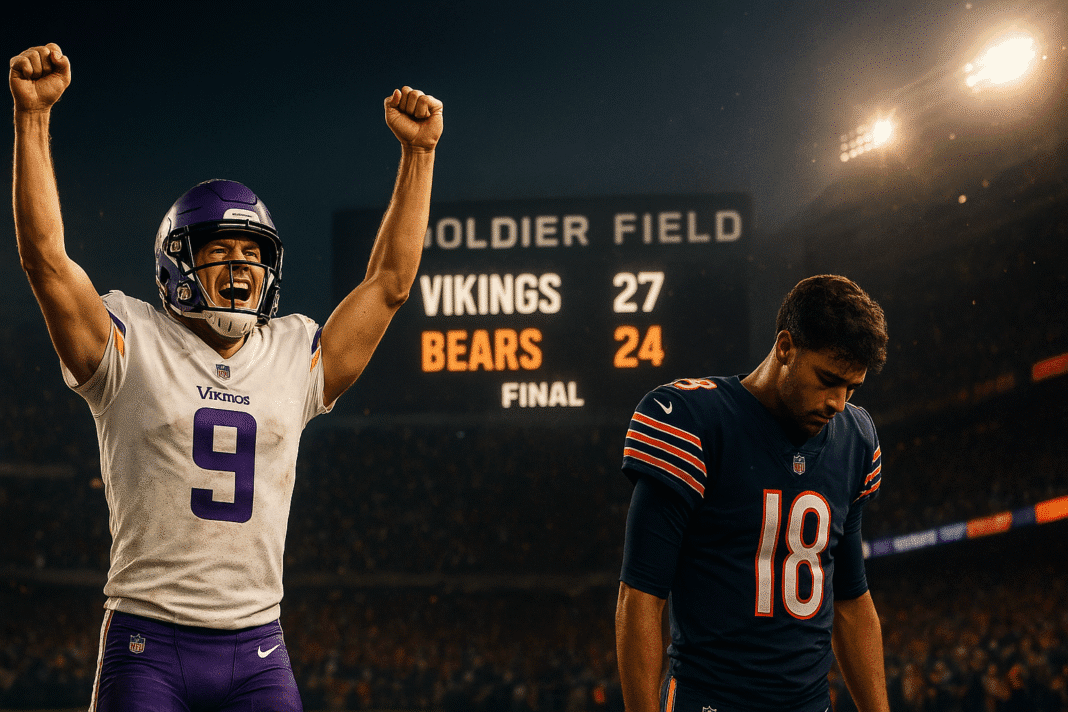
J.J. McCarthy engineered a stunning fourth quarter comeback at Soldier Field on September 8, 2025, scoring three touchdowns in the final period to lift Minnesota over Chicago 27-24 in the season opener. The Vikings rookie quarterback threw for 143 yards and two touchdowns while adding a crucial 14 yard scoring run with 2:53 remaining. Caleb Williams countered with 210 passing yards and 58 rushing yards for the Bears, but Chicago’s 12 penalties for 127 yards and a missed field goal proved costly in the three point defeat.
Quick Game Summary
Final Score: Minnesota 27, Chicago 24
Location: Soldier Field, Chicago
Attendance: 58,742
Conditions: 68 degrees, 38% humidity, 6 mph wind
Game Changers:
- McCarthy’s fourth quarter explosion: 21 points, 3 total touchdowns
- Chicago’s penalty avalanche: 12 flags for 127 yards
- Special teams gap: Reichard 2/2 FG including 59-yarder, Santos 1/2 with crucial miss
- Williams led Bears in rushing (58 yards), exposing ground game struggles
Table of contents
- Quick Game Summary
- Complete Team Statistics
- Quarterback Breakdown
- Ground Game Comparison
- Receiving Production
- Defensive Impact
- Injury Impact on the Game
- Special Teams Difference
- Penalty Problems
- Scoring Summary by Quarter
- Frequently Asked Questions
- Advanced Offensive Metrics
- Red Zone and Situational Performance
- Coaching Impact
- Monday Night Football History
- 2025 Season Implications
- Statistical Summary
Complete Team Statistics
| Category | Minnesota Vikings | Chicago Bears |
|---|---|---|
| Final Score | 27 | 24 |
| Total Yards | 254 | 317 |
| First Downs | 14 | 20 |
| Third Down Efficiency | 3-12 (25%) | 3-12 (25%) |
| Fourth Down Efficiency | 0-0 | 0-1 |
| Time of Possession | 27:07 | 32:53 |
| Penalties-Yards | 8-50 | 12-127 |
| Turnovers | 1 | 1 |
Chicago controlled possession for nearly six more minutes and outgained Minnesota by 63 yards, yet lost by three points. The 77 yard penalty differential equals more than an entire touchdown drive’s worth of field position. Both teams converted just three of twelve third down attempts, but Minnesota executed when the game hung in the balance.
Perfect weather conditions at Soldier Field eliminated any environmental excuses. Both offenses had every opportunity to execute cleanly, making the Bears’ discipline breakdown all the more damaging in Ben Johnson’s head coaching debut.
Quarterback Breakdown
Complete QB Statistics
| Stat Category | J.J. McCarthy (MIN) | Caleb Williams (CHI) |
|---|---|---|
| Completions-Attempts | 13-20 | 21-35 |
| Completion Percentage | 65.0% | 60.0% |
| Passing Yards | 143 | 210 |
| Yards Per Attempt | 7.2 | 6.0 |
| Passing Touchdowns | 2 | 1 |
| Interceptions | 1 | 0 |
| Passer Rating | 98.5 | 86.6 |
| Sacks-Yards Lost | 3-9 | 2-12 |
| Rushing Attempts | 2 | 6 |
| Rushing Yards | 25 | 58 |
| Rushing Touchdowns | 1 | 1 |
| Yards Per Carry | 12.5 | 9.7 |
McCarthy’s Redemption Arc
McCarthy struggled badly through three quarters, throwing an interception that Nahshon Wright returned 74 yards for a touchdown, putting Chicago ahead 17-6 midway through the third. The pick appeared to seal Minnesota’s fate in McCarthy’s NFL debut.
At halftime, Vikings head coach Kevin O’Connell approached his rookie signal caller with a message. “You are going to bring us back to win this game,” O’Connell told McCarthy. O’Connell later described the moment: “The look in his eye was fantastic. The best thing was just the belief I felt from the team, from the unit, and ultimately, that doesn’t get done without him in the second half.”
That vote of confidence changed everything.
McCarthy went to work in the fourth quarter, completing 6 of 8 passes for 65 yards and two touchdowns while adding 14 rushing yards and a touchdown run. He personally accounted for all 21 Minnesota points in the final period.
His scoring drives:
- 13 yard TD pass to Justin Jefferson (6 plays, 60 yards, 2:42)
- 27 yard TD pass to Aaron Jones plus 2-point conversion to Adam Thielen (3 plays, 50 yards, 0:51)
- 14 yard TD run on a designed keeper (9 plays, 68 yards, 4:31)
According to Pro Football Reference’s detailed game analysis, McCarthy’s fourth quarter performance ranks among the best closing quarters by any rookie quarterback in recent NFL history.
Williams’ Efficiency Without Support
Williams opened the game completing 10 consecutive passes, the most by any Bears quarterback to start a season opener since at least 1978. His early accuracy suggested Chicago would control the game.
After that streak, Williams completed just 11 of 25 attempts (44%) as the Bears offense sputtered.
He finished with solid numbers but lacked the support needed to hold Minnesota off. Williams threw for 210 yards on 21 completions with one touchdown and zero interceptions, posting an 86.6 passer rating.
His rushing production exposed a deeper problem. Williams gained 58 yards on six carries (9.7 average), leading Chicago in rushing yards. When your franchise quarterback scrambles for more yards than your running backs gain on designed plays, you have an offensive balance issue.
D’Andre Swift managed just 53 yards on 17 carries (3.1 average), failing to establish any consistent ground threat. Swift gained zero yards on five combined carries in the first and fourth quarters, the two periods where Chicago needed production most.
Ground Game Comparison
| Player | Team | Carries | Yards | Average | Long | Touchdowns |
|---|---|---|---|---|---|---|
| Jordan Mason | MIN | 15 | 68 | 4.5 | 19 | 0 |
| Caleb Williams | CHI | 6 | 58 | 9.7 | 13 | 1 |
| D’Andre Swift | CHI | 17 | 53 | 3.1 | 13 | 0 |
| Aaron Jones | MIN | 8 | 23 | 2.9 | 9 | 0 |
| DJ Moore | CHI | 3 | 8 | 2.7 | 5 | 0 |
| J.J. McCarthy | MIN | 2 | 25 | 12.5 | 14 | 1 |
Jordan Mason gave Minnesota consistent production, churning out 4.5 yards per carry on 15 attempts. His reliability kept the Vikings on schedule, setting up manageable third downs throughout the night. Mason picked up three rushing first downs and gained 41 of his 68 yards after contact, displaying a physical running style that wore down Chicago’s front seven as the game progressed.
The contrast in rushing philosophy showed clearly. Minnesota relied on Mason for designed runs while using McCarthy’s mobility as a change of pace. Chicago became overly dependent on Williams’ scrambling ability, putting unnecessary hits on their most important player.
Receiving Production
Minnesota Vikings Receivers
| Receiver | Targets | Receptions | Yards | Average | Long | Touchdowns |
|---|---|---|---|---|---|---|
| Aaron Jones | 3 | 3 | 44 | 14.7 | 27 | 1 |
| Justin Jefferson | 7 | 4 | 44 | 11.0 | 17 | 1 |
| Jalen Nailor | 3 | 1 | 28 | 28.0 | 28 | 0 |
| T.J. Hockenson | 4 | 3 | 15 | 5.0 | 9 | 0 |
| Jordan Mason | 1 | 1 | 7 | 7.0 | 7 | 0 |
| Josh Oliver | 1 | 1 | 5 | 5.0 | 5 | 0 |
Chicago Bears Receivers
| Receiver | Targets | Receptions | Yards | Average | Long | Touchdowns |
|---|---|---|---|---|---|---|
| DJ Moore | 5 | 3 | 68 | 22.7 | 30 | 0 |
| Olamide Zaccheaus | 7 | 4 | 42 | 10.5 | 16 | 0 |
| Rome Odunze | 9 | 6 | 37 | 6.2 | 17 | 1 |
| Cole Kmet | 4 | 1 | 31 | 31.0 | 31 | 0 |
| Colston Loveland | 2 | 2 | 12 | 6.0 | 8 | 0 |
| D’Andre Swift | 5 | 3 | 12 | 4.0 | 8 | 0 |
| Kyle Monangai | 1 | 1 | 11 | 11.0 | 11 | 0 |
Aaron Jones became Minnesota’s most effective receiver, catching all three targets for 44 yards and the go-ahead touchdown. His 27 yard touchdown reception late in the fourth quarter, followed by a successful two-point conversion, put Minnesota ahead 20-17 with 9:46 remaining. Jones averaged 14.7 yards per catch, providing explosive plays at crucial moments.
Justin Jefferson caught 4 of 7 targets for 44 yards and a touchdown. Chicago successfully limited Jefferson below his career average of 95.8 yards per game, continuing a trend at Soldier Field where he’s been held under 50 yards in four consecutive appearances. Jefferson’s 13 yard touchdown catch midway through the fourth quarter sparked Minnesota’s comeback.
The Vikings extended their winning streak at Soldier Field to five games, a run that began during Jefferson’s rookie season and now spans multiple years of NFC North competition.
DJ Moore led Chicago with 68 yards on three receptions, showing big play ability. Unfortunately, Moore fumbled during a desperate lateral attempt on the final play, allowing Minnesota safety Jay Ward to recover and seal the victory.
Rome Odunze drew nine targets, the most on either team, but averaged just 6.2 yards per catch. His volume production came mostly on short routes rather than downfield attacks. Odunze scored on a 1 yard touchdown pass with 2:02 left that cut Minnesota’s lead to 27-24, but Chicago couldn’t complete the comeback.
Defensive Impact
While the offenses traded scoring opportunities throughout the night, both defenses made crucial plays. Minnesota’s ability to force stops in critical moments differed from Chicago’s fourth quarter collapse.
Minnesota Vikings Defense
| Player | Position | Total Tackles | Solo Tackles | Sacks | TFL | INT | Passes Defended |
|---|---|---|---|---|---|---|---|
| Joshua Metellus | S | 6 | 4 | 0 | 0 | 0 | 0 |
| Javon Hargrave | DT | 5 | 3 | 2 | 2 | 0 | 0 |
| Eric Wilson | LB | 5 | 3 | 0 | 1 | 0 | 0 |
| Andrew Van Ginkel | OLB | 5 | 3 | 0 | 1 | 0 | 2 |
| Isaiah Rodgers | CB | 5 | 3 | 0 | 1 | 0 | 0 |
| Ivan Pace Jr. | LB | 5 | 2 | 0 | 0 | 0 | 0 |
| Byron Murphy Jr. | CB | 4 | 4 | 0 | 0 | 0 | 0 |
| Theo Jackson | S | 4 | 3 | 0 | 0 | 0 | 0 |
Javon Hargrave dominated Williams throughout the night, recording both Minnesota sacks and adding two tackles for loss. His consistent interior pressure disrupted Chicago’s passing rhythm at critical moments.
Chicago Bears Defense
| Player | Position | Total Tackles | Solo Tackles | Sacks | TFL | INT | Passes Defended | TD |
|---|---|---|---|---|---|---|---|---|
| Noah Sewell | LB | 9 | 7 | 0 | 0 | 0 | 0 | 0 |
| Tremaine Edmunds | LB | 7 | 3 | 0 | 0 | 0 | 1 | 0 |
| Kevin Byard III | S | 5 | 5 | 0 | 0 | 0 | 0 | 0 |
| Jaquan Brisker | S | 5 | 4 | 0 | 0 | 0 | 0 | 0 |
| Nahshon Wright | CB | 4 | 3 | 0 | 1 | 1 | 1 | 1 |
| Tyrique Stevenson | CB | 3 | 3 | 0 | 0 | 0 | 1 | 0 |
| Gervon Dexter Sr. | DL | 3 | 2 | 1 | 1 | 0 | 0 | 0 |
Noah Sewell made his first career NFL start a memorable one, leading all defenders with nine tackles while filling in for injured starter T.J. Edwards. Sewell made seven solo stops and helped Chicago’s defense dominate the first three quarters.
The Bears held Minnesota to just 80 total yards and four first downs in the opening half. Chicago forced seven three-and-outs during the game, the most by any NFL defense in Week 1. Minnesota converted zero of five third down attempts in the first half and went 0-for-8 through three quarters.
Then the fourth quarter happened. Everything that worked for Chicago’s defense through 45 minutes fell apart. Minnesota converted 3 of 4 third downs in the final period, picked up nine first downs, and gained 169 yards compared to Chicago’s 63 yards in the same timeframe.
Nahshon Wright provided the defensive highlight, intercepting McCarthy’s pass intended for Jefferson and returning it 74 yards for a touchdown. The score gave Chicago a commanding 17-6 lead with 12:51 left in the third quarter. Wright jumped the route perfectly, caught the ball in stride, and raced down the right sideline untouched for his first career touchdown in his 34th NFL game.
Wright had given up a 42 yard pass interference penalty earlier in the second quarter that moved Minnesota into field goal range. He answered that mistake with the pick six.
Wright spent 2024 with the Vikings before signing with Chicago this offseason, adding an extra storyline to his performance.
Chicago’s defensive line combined for three sacks. Gervon Dexter Sr., Dayo Odeyingbo, and Tanoh Kpassagnon each recorded one. Kpassagnon’s sack marked his first since December 17, 2023, when he notched three sacks while playing for New Orleans in Dennis Allen’s defense.
Injury Impact on the Game
Chicago played without three key defensive starters. Linebacker T.J. Edwards (hamstring), cornerback Jaylon Johnson (calf and groin), and nickel back Kyler Gordon (hamstring) all sat out the opener. Edwards’ absence forced Noah Sewell into starting duty. Johnson, one of the league’s premier cornerbacks, would have been assigned to shadow Justin Jefferson. Gordon’s missing presence left holes in slot coverage that Minnesota attacked.
The Bears lost linebacker Blake Cashman during the game to a hamstring injury. Cashman will undergo an MRI to determine severity. Cornerback Jeff Okudah was evaluated for a concussion after taking a hit late in the contest.
Minnesota played without veteran safety Harrison Smith, who didn’t travel due to illness. Offensive tackle Christian Darrisaw, recovering from a torn ACL suffered last season, remained inactive for the season opener. Despite these absences, Minnesota’s depth held up on the road.
Special Teams Difference
The kicking game directly influenced the outcome, but Chicago’s discipline problems compounded their issues.
| Category | Minnesota Vikings | Chicago Bears |
|---|---|---|
| Field Goals Made-Attempted | 2-2 | 1-2 |
| Longest Field Goal | 59 yards | 42 yards |
| Extra Points Made-Attempted | 1-1 | 3-3 |
| Total Kicking Points | 7 | 6 |
| Punts-Average | 7-47.6 | 6-44.3 |
| Net Punting Average | N/A | 33.0 |
| Punts Inside 20 | 0 | 1 |
Will Reichard went 2-for-2 on field goal attempts, delivering a perfect performance in his NFL debut. His 59 yard field goal with six seconds remaining in the first half tied a Soldier Field record and kept Minnesota within 10-6 at intermission.
That kick kept the Vikings within one score rather than trailing by two possessions.
Reichard’s 31 yard field goal in the second quarter kept the Vikings within striking distance during Chicago’s dominant first half.
Cairo Santos converted 1 of 2 field goals, missing from 50 yards on the opening play of the fourth quarter. In a game decided by three points, that miss looms large.
Santos made all three extra points and hit from 42 yards, but the missed opportunity breathed life into Minnesota’s comeback.
To compound matters, Santos failed to kick the ball through the end zone on his kickoff with 2:02 remaining. Luther Burden returned it 44 yards, giving Chicago decent starting field position for what would be their final possession.
The special teams battle created a six point swing that exceeded the three point final margin. Reichard’s made 59-yarder added three points. Santos’ miss subtracted three potential points from Chicago’s total.
Penalty Problems
| Team | Total Penalties | Total Yards | Critical Situations |
|---|---|---|---|
| Chicago Bears | 12 | 127 | Multiple drive extensions |
| Minnesota Vikings | 8 | 50 | Mostly late game |
Chicago committed 12 penalties for 127 yards, their highest total since November 8, 2021, when they were flagged 12 times in a loss at Pittsburgh. The 77 yard difference in penalty yardage equates to more than a full touchdown drive of field position handed to Minnesota.
Major infractions included:
Nahshon Wright: 42 yard defensive pass interference (2nd quarter)
Dayo Odeyingbo: 15 yard roughing the passer (3rd quarter)
Tyrique Stevenson: 14 yard defensive pass interference (4th quarter)
Jonah Jackson: Three separate false starts (5 yards each)
Darnell Wright: Two offensive holding penalties (10 yards each)
Carl Jones: 10 yard offensive holding on punt return (3rd quarter)
The Bears committed penalties across all three phases. False starts by the offensive line repeatedly created second-and-long or third-and-long situations that became nearly impossible to convert. Defensive pass interference calls extended Minnesota drives at crucial moments. Even special teams contributed with holding penalties on returns.
According to the official Bears game recap, head coach Ben Johnson acknowledged the discipline breakdown: “We made too many mistakes there late in the game, myself included. There were a number of things I could have done better, there were a number of things a lot of guys could have done better.”
Minnesota committed eight penalties for 50 yards, with most coming late in the game as they tried to protect their lead.
Scoring Summary by Quarter
| Quarter | Minnesota Vikings | Chicago Bears |
|---|---|---|
| 1st | 0 | 7 |
| 2nd | 6 | 3 |
| 3rd | 0 | 7 |
| 4th | 21 | 7 |
| Final | 27 | 24 |
The fourth quarter breakdown shows exactly how Minnesota pulled off the comeback. The Vikings outscored Chicago 21-7, outgained them 169-63 in total yards, and converted 3 of 4 third downs while the Bears went 1 of 4. Minnesota picked up nine first downs in the final period compared to Chicago’s seven.
Chicago’s defense forced Minnesota into negative situations repeatedly through three quarters but couldn’t hold that standard when the game reached its critical stage.
Minnesota’s three fourth quarter scoring drives consumed the clock and demoralized Chicago’s defense:
Drive 1: 6 plays, 60 yards, 2:42, McCarthy 13 yard TD pass to Jefferson
Drive 2: 3 plays, 50 yards, 0:51, McCarthy 27 yard TD pass to Jones + 2pt conversion
Drive 3: 9 plays, 68 yards, 4:31, McCarthy 14 yard TD run
You can review the complete NFL play-by-play data showing how each drive unfolded and the specific plays that changed momentum.
Chicago’s defense forced Minnesota into negative situations repeatedly through three quarters but couldn’t maintain that level when the game reached its critical stage.
Frequently Asked Questions
Minnesota Vikings won 27-24 after trailing 17-6 in the third quarter. J.J. McCarthy scored three fourth quarter touchdowns (two passing, one rushing) to complete the comeback at Soldier Field.
McCarthy completed 13 of 20 passes for 143 yards, two touchdowns, and one interception. He added 25 rushing yards and a touchdown on two carries. McCarthy struggled through three quarters before dominating the fourth period with 21 points scored.
Williams completed 21 of 35 passes for 210 yards, one touchdown, and zero interceptions. He led Chicago in rushing with 58 yards on six carries and scored a rushing touchdown. Williams posted an 86.6 passer rating.
Chicago committed 12 penalties for 127 yards, missed a crucial field goal, and allowed 21 unanswered fourth quarter points. The Bears led 17-6 entering the fourth but couldn’t maintain their defensive dominance.
The Bears were flagged 12 times for 127 yards, their most penalties since November 8, 2021. The violations included pass interference calls, false starts, holding penalties, and roughing the passer.
Advanced Offensive Metrics
Minnesota’s efficiency numbers explain the comeback despite Chicago’s 63-yard advantage in total yardage.
Passing Efficiency Breakdown
| Metric | J.J. McCarthy | Caleb Williams |
|---|---|---|
| First Down Passes | 5 | 10 |
| First Down % | 21.7% | 27.0% |
| Intended Air Yards | 137 | 262 |
| Air Yards Per Attempt | 6.9 | 7.5 |
| Completed Air Yards | 75 | 133 |
| Yards After Catch | 68 | 77 |
| Bad Throws | 3 | 9 |
| Bad Throw % | 15.0% | 26.5% |
| Drops | 0 | 1 |
| Times Blitzed | 3 | 11 |
| Times Hurried | 1 | 7 |
| Times Hit | 2 | 2 |
Williams attempted more difficult throws than McCarthy, evidenced by his 262 intended air yards compared to McCarthy’s 137. However, Williams recorded nine bad throws (26.5%) compared to McCarthy’s three (15.0%). Chicago’s quarterback faced pressure from 11 blitzes and was hurried seven times, forcing him into uncomfortable situations repeatedly.
Rushing Performance Analysis
| Metric | Minnesota | Chicago |
|---|---|---|
| Total Rushing Attempts | 26 | 26 |
| Total Rushing Yards | 120 | 119 |
| Average Per Carry | 4.6 | 4.6 |
| Yards Before Contact Per Rush | 1.0 | 1.0 |
| Yards After Contact Per Rush | 3.5 | 3.6 |
| Explosive Runs (10+ yards) | 4 | 4 |
| Yards on Explosive Runs | 62 | 51 |
| Tackles For Loss | 3 | 2 |
| Yards Lost on TFLs | 6 | 4 |
| Missed Tackles Forced | 4 | 3 |
Surface level, both rushing attacks appear identical. Both teams ran 26 times for roughly 120 yards (4.6 average). Both generated four explosive runs. The difference comes in composition and sustainability.
Minnesota generated balanced production from Jordan Mason’s designed runs while using McCarthy’s mobility as a complementary weapon. Chicago relied too heavily on Williams’ scrambling ability, asking their franchise quarterback to make plays with his legs on broken pass plays rather than establishing a ground game through their running back.
Expected Points Added (EPA) numbers show Minnesota posted +0.03 EPA per rush (71st percentile), while Chicago generated +0.08 EPA per rush (79th percentile). Despite Chicago’s slight edge in rushing efficiency, Williams’ passing attack produced negative 0.15 EPA per pass, meaning the Bears frequently lost ground on dropbacks.
Red Zone and Situational Performance
| Category | Minnesota Vikings | Chicago Bears |
|---|---|---|
| Red Zone Possessions | 3 | 2 |
| Red Zone TDs | 2 | 2 |
| Red Zone FGs | 1 | 0 |
| Red Zone Efficiency | 100% | 100% |
| Third Down Conversions | 3-12 | 3-12 |
| Fourth Down Conversions | 0-0 | 0-1 |
| Two Point Conversions | 1-2 | 0-1 |
Both teams converted every red zone possession into points, showing efficiency inside the 20. The difference emerged in field position and scoring opportunities created through special teams and penalties.
Minnesota succeeded on 1 of 2 two-point conversion attempts. McCarthy hit Adam Thielen on the go-ahead touchdown to make it 20-17. Earlier, Josh Oliver caught McCarthy’s pass but safety Jonathan Owens made an excellent tackle short of the goal line. Chicago went 0-for-1 on two-point tries, failing after their second touchdown.
Coaching Impact
Ben Johnson’s debut as head coach featured aggressive fourth down decisions early that mostly succeeded but conservative play calling late that backfired. After building a 17-6 lead, Chicago’s offense became predictable. The Bears ran on first down repeatedly in the fourth quarter, allowing Minnesota’s defense to anticipate passing situations.
Kevin O’Connell’s fourth quarter adjustments changed the game. Minnesota’s offense executed at a higher level in the final period, converting 3 of 4 third downs after going 0-for-8 through three quarters. The Vikings scored on three consecutive possessions, with McCarthy completing 6 of 8 passes for 65 yards and two touchdowns while adding a 14-yard scoring run. O’Connell’s confidence in McCarthy after the interception showed in the results, as the rookie quarterback responded with flawless execution when the game was on the line.
Timeout management in the final two minutes exposed the experience gap. Johnson burned all three timeouts trying to preserve time after Minnesota’s final touchdown. His offense got the ball back at their own 20 yard line with just nine seconds remaining but couldn’t execute. The final play epitomized desperation: Williams threw short to Rome Odunze, who lateraled to DJ Moore. Moore gained yardage but fumbled, allowing Minnesota safety Jay Ward to recover and secure the 27-24 victory.
Monday Night Football History
This matchup marked the 19th Monday Night Football game between these NFC North rivals. Minnesota improved to 8-3 in Monday night contests played in Chicago, continuing their recent dominance under the prime time lights.
The Vikings extended their winning streak at Soldier Field to five consecutive games, a run that began during Justin Jefferson’s rookie campaign and now spans multiple seasons of division competition.
2025 Season Implications
Minnesota’s ability to convert 3 of 4 fourth quarter third downs after going 0-for-8 through three quarters shows how O’Connell’s tempo changes and personnel adjustments exploited Chicago’s fatigued secondary. The Vikings now have a rookie quarterback who completed 6 of 8 passes under maximum pressure in the final 15 minutes of his debut.
Chicago’s 12 penalties for 127 yards problem extends beyond discipline. Six of those flags came from the offensive line (false starts and holding), indicating communication breakdowns in their first game together. Swift’s 3.1 yards per carry average on 17 attempts gives Chicago nothing to build an offense around. The Bears need a reliable ground game, especially in an NFC North division where the Detroit Lions and Green Bay Packers can control clock and weather games in November and December.
The special teams gap matters more than most realize. Reichard’s perfect performance versus Santos’ miss created a six point swing in a three point game. Chicago needs kicking reliability from beyond 50 yards in a division where late-season weather makes field goals crucial.
Statistical Summary
Three factors decided this game despite Chicago’s advantages in yards, first downs, and possession time.
First, McCarthy’s fourth quarter execution: 6-for-8 passing, two touchdown passes, and one rushing touchdown in the final 15 minutes erased an 11 point deficit. Second, special teams: Reichard’s perfect 2-for-2 including a 59-yard field goal versus Santos’ 1-for-2 with a crucial fourth quarter miss created a six point differential in a three point game. Third, discipline: Chicago’s 12 penalties for 127 yards extended Minnesota drives while killing their own, with six flags coming from offensive line breakdowns.
O’Connell’s halftime message to McCarthy, the tempo increase that caught Chicago’s defense unprepared, and Reichard’s Soldier Field record kick combined to overcome a significant yardage deficit and deliver Minnesota’s fifth consecutive win at this stadium.
Stats compiled from official NFL game data, Pro Football Reference, and team box scores and Match Player Stats.
Game played September 8, 2025 at Soldier Field, Chicago.